




 It happens pretty often, Some article in phys,org exactly profiles a problem beavers could help with if we just stopped killing them but the article itself never once mentions this actual solution. We call these the beaver-articles-without-beavers and this example sent by Bob Kobres of Georgia is an excellent demonstration.
Groundwater pumping has significantly reduced US stream flows
 Groundwater pumping in the last century has contributed as much as 50 percent to stream flow declines in some U.S. rivers, according to new research led by a University of Arizona hydrologist.
The new study has important implications for managing U.S. water resources. Laws regulating the use of groundwater and surface waters differ from state to state. Some Western states, Arizona among them, manage groundwater and surface water separately.
The scientists focused particularly on the Colorado and Mississippi River basins and looked exclusively at the effects of past groundwater pumping because those losses have already occurred.
The U.S. Geological Survey has calculated the loss of groundwater over the 20th century as 800 cubic kilometers, or 649 million acre-feet. That amount of water would cover the states of Montana, Idaho, Wyoming, Nevada, Utah, Colorado, Arizona and New Mexico, plus most of California, with water one foot deep.
Imagine everyone in your state is sharing an ice cream soda by sipping from a straw at the counter. Only this ice cream soda feeds humans and crops and tap water for the entire state Would it matter if more people came to share the soda or if some folks were sipping twice as hard? You bet it would.
If only there were some kind of natural way to replenish and recharge groundwater. Dam.
“We showed that because we’ve taken all of this water out of the subsurface, that has had really big impacts on how our land surface hydrology behaves,” she said. “We can show in our simulation that by taking out this groundwater, we have dried up lots of small streams across the U.S. because those streams would have been fed by groundwater discharge.”
Groundwater helps provide water to existing vegetation, including crops, Condon said.
Receding water tables and dwindling streams can make irrigating crops more difficult and costly. Some native vegetation including cottonwood trees will eventually die if the water table drops below their roots.
Groundwater is often the slowest component of the terrestrial hydrologic system to recover from losses, Condon said.
Gosh, groundwater sure sounds important. I bet if there were some kind of simple solution folks would JUMP at the  chance to recharge it. RIght?
The regions most sensitive to a lowering of the water table are east of the Rocky Mountains, where initially the water table was shallow, at the depth of 6-33 feet (2-10 meters), she said. In those regions, groundwater and surface water are more closely linked, and depleting the groundwater is more disruptive to vegetation, streams and rivers.
Other research has shown that parts of the Midwest where the amount of precipitation used to equal the evaporative demand—meaning plants didn’t need irrigation—are becoming more arid, she said. Those are some of the regions where groundwater pumping has reduced surface waters.
You mean all those arid, farming states that are so intolerant of beavers? Like Oklahoma and Kansas? They’re the most vulnerable to drought because they have the weakest groundwater? And they kill beavers the fastest?
It’s darn ironic isn’t it that the places that need water-savers the most tolerate them the least.

 Following public objections and opposition from some unlikely camps, wildlife managers are walking back plans to open up an array of Jackson Hole streams to unlimited beaver trapping.


 And really, biologists should not bounce on lodges. Just sayin’. Sheesh.

 enchiladas. That’s Mary O’brien, Mike Callahan, Sherri Guzzi, Michael Pollock and his girlfriend the tribal lawyer seated around the table. It was a pretty fun night of conversation, laughter and beers that geared us up for our big days ahead.
 Plus tons of excellent information about beavers

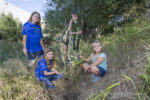
 Watershed Restoration Citizen Science Project
 Artemis is really excited to get our boots on the ground and our waders in the water this summer by partnering with the
  The Greek goddess Artemis is the protector of the hunt and of nature. She is usually depicted with her trusty doe deer, a bow and arrows. She knew it as her duty to protect wildlife and the sanctity of the hunt. Artemis sees her as an extremely fitting icon to represent our philosophy. We embody Artemis’ wild spirit and protective nature to boldly carry the conservation torch for the modern sportswoman by engaging in every facet of the sporting conservation life.
 Beavers are a keystone species. This means they modify their environment in a way that influences the whole ecosystem.
 Beavers build temporary dams on small streams, which slows down rainwater runoff and snowmelt. This water is held at a higher point in the watershed. Over the summer, it seeps out slowly, replenishing groundwater and providing essential stream flows during the hottest and driest months in the late summer and fall. This keeps stream temperatures down, helping native fish that need colder water and avoiding hoot owl restrictions.