




Because the beaver isn't just an animal; it's an ecosystem!


FacebookFacebook
email articleemail article

There are two pieces of great news that make this morning seem luxurious. The first is that I got my “W” key back – it had stopped working entirely and I as forced to paste it in or find another way to say the words  work, wonder and why. The vast internet(s) helped me find  out how to reprogram my keyboard and now my F2 key is behaving like a w, so I’m THRILLED. (Now if I can just reprogram my finger to remember that we’re in business.)

The second is this delightfully guilty pleasure I think you will share reading this article about the end of trapping in California – I imagine for many, many people it’s producing a thrill akin to watching porn. As a woman whose written about the ‘dying noble trapper‘ articles that appear religiously from Nebraska to Alberta every single winter, it is truly wonderful. Get your popcorn or your donut and settle in because honestly it’s that good.

As anti-fur sentiment grows, California’s oldest trappers are calling it quits

After a lifetime spent trapping animals in California’s western Sierra Nevada, Tim Wion traveled to Oregon recently to make one big, final sale at the annual Klamath Falls fur auction.

Unlike his fellow woodsmen, however, Wion wasn’t hawking the luxuriant pelts of wolves, bobcats, otters, coyotes, foxes and muskrat. Instead, the 75-year-old was selling off the many foothold traps and fur-stretchers that once provided him a livelihood.

“I’ve got no use for them,” Wion told a reporter. “Trapping is dead in California.”

See what I mean? That kind of start to an article right away makes you want to lean back on one elbow in bed and smoke a cigarette. Savor it all. It gets better.

A San Francisco ban on fur sales took effect in January, while two bills in the state Legislature seek to ban trapping for commercial purposes and outlaw the sale of fur products statewide. At the same time, a coalition of animal rights activists called Direct Action Everywhere is stepping up demonstrations at fashion shows and department stores.

“I’ve been on the front lines of this battle since the 1990s,” Aiton said. “But there will be no fighting this time. I’m 77 and … my health won’t allow me to fight one more minute.”

“They won. We lost,” Aiton said.

“My association is not fighting back because trapping is a dead horse in California,” Aiton said, “and there isn’t a dad gum thing we can do about it.”

Oh that’s sweet. The reporter who wrote this must know it’s sweet, right? I mean Mr. Louis Sahagun couldn’t be thinking readers would be sad or wistful when they read this, right? He’s got to know he’s giving a lot of people a lot of cheap thrills.

One of the bills slated for a final vote this summer was introduced by Assemblywoman Lorena Gonzalez (D-San Diego), who argues that there are so few active trappers in the state that their license fees no longer cover the expense of regulating the industry.

A total of 68 trappers reported killing 1,568 animals statewide in 2017, according to the most recent data available from the California Department of Fish and Wildlife. Among the 10 species reported taken were coyote, gray fox, beaver, badger and mink.

The revenue received by the Department of Fish and Wildlife for the sale of their trapping licenses was $15,544 and $709 for the sale of fur dealer licenses, officials said. Many of those trapping licenses were held by pest control companies.

The costs of regulating trappers doesn’t even pay for itself anymore! Mind you, I’m enjoying this too much to even begin to talk about the unregulated free-for-all that is depredation. Apparently California is just fine with killing animals as long as you don’t wear them afterwards, but that’s a fight for another day. Let’s just enjoy this for now shall we?

“What’s happening in California is too bad,” Nichols said. “We see the problem there as a movement of people who regard wild animals as almost human-like.”

Ahh, I can’t believe this article is going to make us all climax again so soon, but shh, here’s my favorite part.

Trapping advocate Nick Catrina, who runs a pest control business in Stockton, offers a less politically correct reason for trapping’s demise in the Golden State.

“Animal rights activists are terrorist groups, mostly led by lesbians, who destroy property and burn down animal research facilities for their cause,” Catrina said. “And progressives, in their march toward communism, are trying to ban trapping. They’ll get rid of hunting too after they take over the government of the United States.”

Communist lesbian terrorists! The indigo girls perform Karl Marx with pipe bombs?

Lions and tigers and bears! Oh my goodness this article is so delicious it should be fattening.  I just want to stash it in a brown paper bag and place it under the bed so I can read my favorite parts over and over again every night.  I just can’t think of anything better that he forgot to mention. The funny part is that I recognize Mr. Catrina’s name from reading years of beaver depredation permits. I guess sometimes he moonlights in pest control. Next time I’ll say hi!

Today, trappers who were taught the secrets of their trade before their teens by older friends and relatives are feeling isolated.

“Old trappers are dying off,” Aiton said, “and not being replaced by younger ones.”

He realized that trapping was in trouble in California when, he said, “I ran out of world — the places I used to trap were covered with new homes and tough laws.”

The article ends with the wistful mention of his placing a live trap on his front porch to catch the occasional opossum or raccoon and watching them walk off merrily into the sunrise as he whispers goodbye, but it’s too late.

By then we are already lost in the the glorious sunrise of our own.


FacebookFacebook
email articleemail article

Mondays are hard. Everyone knows that. So what we really need is some kind of enthusiasm-booster chair, to help us see over the dreary week’s work ahead. Okay, you deserve it. Here’s just the thing.

Mickey the Beaver

Mickey the Beaver came into the life of Doris Forbes and her parents in 1939. High school student Jean Yuill found the kit on a sidewalk in Red Deer, Alberta, and happened to bring him to the nearby Forbes home.

The family nursed the injured kit back to health, raising him from when he was only twenty-five centimetres long until he was more than a metre in length.

Can you imagine Mikey’s life? Dressed in doll clothes or pushed in a stroller to a tea party here all the other children ooh and ahh over his curious tail? Doris’ unique pet has been discussed on this site before. There is even a statue dedicated to her in Red Deer Park. Mickey must have been a kind of cash monkey. In this photo he’s posing with a “Dainty white loaf” Beavers, by the way, do not eat bread. It makes them constipated I have heard.

Mickey would come when called by name and would go for swims in the nearby creek, always following the family home. He’d even make dams out of slippers in their home — after the family trained him to stop gnawing at the furniture.

When Doris Forbes was sick, Mickey would go to her bedroom every day to visit — the beaver even caught whooping cough from the young girl. The two were inseparable; Mickey was Doris’s best friend.

“He’s the best pet I ever had, and I love him with all my heart,” she said.

Now that I completely believe. Beavers are very social and personable and a pet orphan is likely to be very demonstrative of affection, because he is missing any. No word yet on what all the trappers of the day, who love to describe beavers as vicious and aggressive, thought of this sweet story. They surely must of heard it because Doris and Mickey were  big news.

When “The Tale of Mickey the Beaver” (The Beaver, December 1941) was published, the Forbes had been raising Mickey for more than two years. This is just one of the stories you’ll find in our online archive of The Beaver, Canada’s History, and Kayak magazines. Using the new online search function, search “Mickey the Beaver” to see even more photos of Doris and her furry friend.

Ahh Mickey I hope you life ended kindly and you got to live in someones pond or something. Searching the Canadian archives looks like fun. Thanks for the rainy day suggestion! There’s even a section just on Voyageurs and lots of info about the fur trade. Just in case readers need  to learn more about this story, here’s a short video of her story and statue by a recent visitor.


FacebookFacebook
email articleemail article

When the beaver revolution finally comes to Texas – and mark my words, it will come – it will be to somewhere like Tyler, where we already met at least two unrelated stories about women trying to save beavers on their little community lake. The first was Carmen Sosa, a staunch beaver defender that still donates to Worth A Dam every month, and the second is our new friend Brittany Poster Oak Hollow.

Residents speak out on beaver trapping in south Tyler neighborhood

TYLER, TX (KLTV) – Since the first of the year, beavers have been causing problems at a lake in the Oak Hollow neighborhood in south Tyler.

And they are taking care of it using a trapper hired by the property owner’s association through the property manageme

nt company.

Okay this you expect from Texas. But this next paragraph not so much.

“I just think there could be a peacful resolution for both the residents and the wildlife,” resident Brittany Poster said.Poster says while she understands the Beavers are a problem, she doesn’t agree with how that problem is being handled.

“The way that they were originally trapped is they just left them that way, “I felt that was both dangerous to the residents, our pets, and our children who use that lake. But it also seemed unfair to the beavers, who were just trying to make a home.”

Well said, Brittany, now if only there were a few more of you and a few less of these:

“We know it’s going to undermine the shoreline and they’re headed to the root system of the trees and we certainly don’t want to lose the trees,” resident Gene Shull said.

“We’re just really interested in protecting the lake and protecting our trees,” Shull said. “And we don’t want to be liable to misfortunes that we didn’t try and take care of.”

Game Warden Captain Quint Balkcom says that beavers can cause big problems and while they can be relocated, it’s not the best option.

Okay, saving beavers is never easy. It always takes more effort than you think you can spare. Step one is to talk to the media, which you’ve done. And step two is to UNION-IZE. Talk to your neighbors and that woman down the street who took your parking place, that nice mom with three little girls,  and that english teacher you never liked. Find allies. All the allies, not just the ones who bring brownies to the meeting. Some of them will be flakes, some will be really annoying, and some will become your friends for life.

It takes a village to save a beaver. It really does. For some reason the voice of trapping is always louder than the other one. Even if it’s one against a dozen. You have to team up. Do everything at once. Fight the battle on many fronts. That’s what happens when you start a beaver-union.


FacebookFacebook
email articleemail article

“Lefty”, the Pokesberry creek beaver, had cautious observers last night. They noticed that he appears to use his hand – just not his arm. They are concerned about grooming  – that makes sense – but hopefully he can persuade a family member to do that side – and the temperature stays mild – for the time being things seem stable, Stay tuned.

Meantime there’s a nice beaver article about restoring beavers for fish that deserves our attention. In Washington of course. It looks to be a re-work of the academy of sciences article but that’s just fine. Of course you already know who its by, right?

They Will Build it

The sentiment that Castor canadensis is little more than a tree-felling, water-stealing, property-flooding pest is a common one. In 2017, trappers in Washington State killed 1,700 “nuisance” beavers, nearly 20 times more than were relocated alive. In neighboring Oregon, the herbivorous rodents are classified as predators, logic and biology notwithstanding. California considers them a “detrimental species.” Last year alone, the U.S. Department of Agriculture eliminated more than 23,000 conflict-causing beavers nationwide.

Running countercurrent to this carnage is another trend: the rise of the Beaver Believer. Across North America, many scientists and land managers are discovering that, far from being forces of destruction, beavers can serve as agents of water conservation, habitat creation, and stream restoration. In Maryland, ecologists are promoting beaver-built wetlands to filter out agricultural pollutants and improve water quality in Chesapeake Bay. In North Carolina, biologists are building beaver-like dams to enhance wet meadows for endangered butterflies. In England, conservationists have reintroduced the Eurasian beaver (Castor fiber) in hopes that their pond complexes will attenuate destructive floods. And in Washington, where a century of habitat loss has devastated salmon, the Tulalip Tribes are strategically dispatching beavers to support the fish so integral to their history and culture.

Where there’s a beaver there’s a believer, I always say!  Our favorite thing EVER is for beavers to go where they choose and people adapt, but this ain’t bad either.

That beavers benefit salmon is, in some quarters, a provocative claim. Many biologists historically regarded beaver dams as stream-choking barriers to fish passage. In the 1970s, Washington, Oregon, and California even passed laws mandating the removal of in-stream wood, beaver dams included. More recently, a 2009 proposal funded by the Atlantic Salmon Conservation Foundation suggested eradicating beavers from 10 river systems on Prince Edward Island and employing trappers to enforce “beaver free zones” in others.


The notion of purging beaver dams to allow salmon to pass, however, doesn’t stand up to scientific scrutiny. One 2016 study documented individual salmonids traversing more than 200 beaver dams on their way to spawn in Oregon streams, suggesting that fish have little trouble negotiating the obstacles. Far from harming salmon, in fact, beavers create indispensable fish nurseries. By filling up ponds and digging canals, beavers engineer the deep pools, lazy side channels, and sluggish backwaters that baby salmon need to conserve energy and evade predators like great blue herons. Today, the National Marine Fisheries Service considers “encouraging formation of beaver dams” vital for recovering Oregon’s endangered coho populations.

Of course beavers are good for salmon. Remember that there used to be millions more of both species, and no one to rip out the dams.  How do you think that ever happened?

“Beavers create complex habitat and enhance local biological diversity in a way that’s really unique,” says Michael Pollock, an ecosystems analyst at the National Oceanic and Atmospheric Administration who’s among the beaver movement’s grandfathers. “They do a much better job of managing these systems than we do.”
Well of course they do. It’s a long article with all kinds of awesome running through it. You might want to go see for yourself.  I will just leave you with some pithy closing arguments.
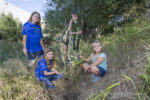
While expanded ponds are beavers’ most visible hydrologic impact, their ability to recharge groundwater might be an even greater contribution. At the Tulalip’s relocation sites, Ben Dittbrenner has found that for every cubic meter (264 gallons) of surface water beavers impound, another 2.5 cubic meters (660 gallons) sinks into the earth. As that water trickles through the soil, it cools off, eventually reemerging to mingle with streamflows downriver. Elsewhere, such hyporheic exchange between surface- and groundwater keeps streams hydrated later into the dry season, turning seasonal creeks perennial. Dittbrenner’s research suggests that beaver-facilitated cooling and mixing also reduces water temperatures by more than 2 degrees Celsius (about 3.5 degrees Fahrenheit), a huge boon for heat-sensitive salmon and trout.

Although beavers won’t singlehandedly save us from climate change, such findings suggest they might be able to help our stressed water supplies adapt to a warmer future. “By 2100, we’re expecting to see snowpack, which is basically our water storage reservoir, disappear throughout a lot of the Cascades,” Dittbrenner says. “I’m curious whether beavers could make up an appreciable storage component of that lost snowpack.”

Ahh Ben! Whatever are we ever going to do without you? Be very, very sorry, that’s for sure. I found out recently that he won’t be able to make it to the festival this year because he’s going to be sent to South America to write about CAPYBARA fer crying out loud.

Talk about your rodenta non grata!

NOT A BEAVER

FacebookFacebook
email articleemail article

Regular readers of this website might remember the story of Nevers park in Connecticut, where there was a plan trap the beavers once the freeze unfroze. There was ample outcry on the ground and I thought there might be enough public support to change the outcome. This morning I read this from Steve of Ct.

Some local success in South Windsor, CT. After promising not to, our head of parks had traps set for our beavers in a local park. Someone posted that on Facebook, I snagged a town council member on the way to their meeting, after which the mayor called me at home and we talked. This morning he called again to say the traps were being removed and he was calling Mike Callahan to schedule an assessment. Not a bad way to start the day!!!

And thus begins another urban beaver success story, only this time they only had to call in the expert from 30 miles away not 3000. The joys of living on the east coast eh? I sense great things for the beavers in Nevers Park. Good luck team, you are in great hands.

I also received a worried message message from our beaver-watching buddies in North Carolina in Pokeberry Creek, Apparently one of the yearlings hasn’t been using his right front paw and they are wondering whether to involve a rehabber.


Yup it definitely looks like its hurting. I’m asking some rehab friends for advice. But it’s a big deal to trap and take it to be treated, and my friend Lisa reminds me that casting is really hard with an aquatic animal. Since its a front paw on a beaver – and not all that important – I’d be inclined to make sure it has plenty of food within swimming distance and wait. But what do I know so we’re asking the experts.

Meanwhile there’s strangely beautiful story out of Utah.

School Board approves wetland, bike trail project near Jeremy Ranch Elementary

The land around Jeremy Ranch Elementary School will be getting a makeover in a few months as Summit County plans for a major construction project.

To accompany two roundabouts the county plans to construct in the spring, it will be restoring the wetlands around the elementary school and building a bike path for students. The Park City Board of Education approved the county’s Wetland Mitigation Plan and easements to create a new trail at its meeting last week.

Wonderful! Wetlands, elementary school, bike path, sounds perfect. What’s the weird part?

According to the county’s mitigation plans, it intends to reroute Toll Creek east of the culvert into a new channel. The county will then install beaver dams and berms and plant willow cuttings to slow down the stream so the wetlands can re-form. The idea is that flora and fauna that left the area when the wetlands dried up will return, Hauber said at the meeting.

“For the school, it gives an opportunity for outdoor science because they can go out and actually see a wetland,” Hauber said.


BEAVER FESTIVAL XVII

DONATE

Beaver Interactive: Click to view

TREE PROTECTION

BAY AREA PODCAST

Our story told around the county

LASSIE INVENTS BDA

CONTACT US

URBAN BEAVERS

LASSIE AND BEAVERS

Ten Years

The Beaver Cheat Sheet

Restoration

RANGER RICK

Ranger rick

The meeting that started it all

Past Reports

June 2026
M T W T F S S
1234567
891011121314
15161718192021
22232425262728
2930  

Story By Year