




I am getting behind in beaver news stories. They have been piling up in my inbox. So let’s have a full smorgasbord today. Starting with Cedar Mill in Oregon.
Go Beavs!
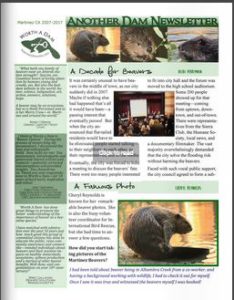
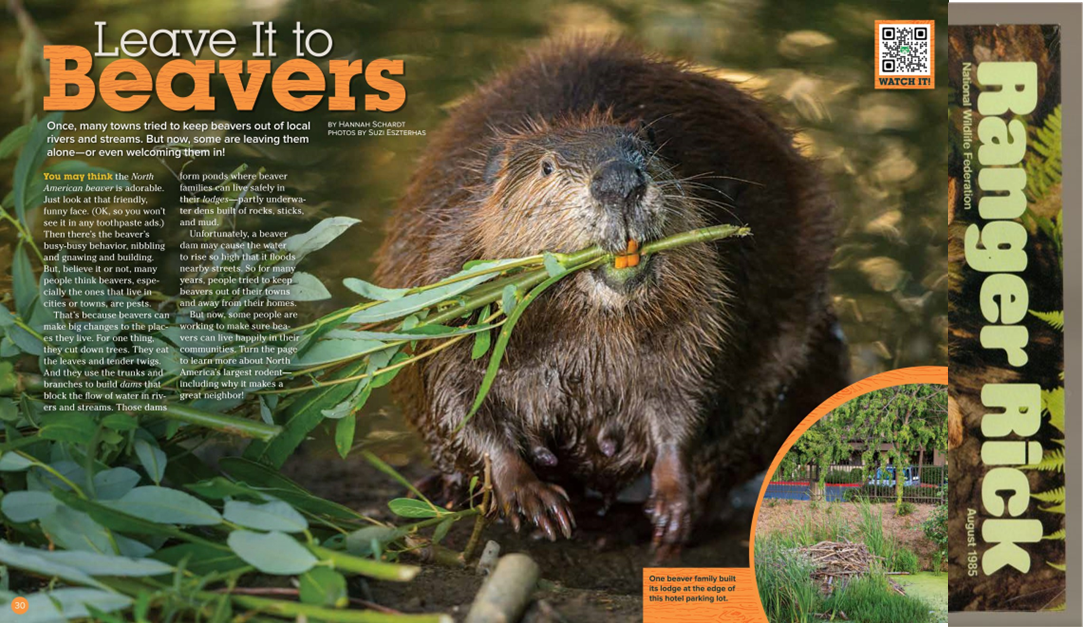
 This article pertains not to OSU sports teams, but instead to North America’s largest rodent, a common resident of Cedar Mill and Oregon’s state animal. The American beaver (Castor canadensis) was trapped almost to extinction across America by the 1800s, due largely to demand for beaver pelts. The undercoat of beaver fur is dense, and each hair is covered with tiny barbs that lock together – qualities that allow production of durable felt that can be formed into hats. Those top hats gentlemen doffed back in the day were made from beaver felt. However, after silk hats became fashionable in the 1840s, decreasing demand for beaver fur allowed these unique animals to make a remarkable come-back.
Beavers provide a variety of ecological benefits. Their ponds provide habitat for fish, amphibians, waterfowl, and songbirds. Beaver dams regulate water flow, decreasing downstream flooding in the winter and helping maintain higher streamflow in the summer. The ponds also improve water quality by trapping sediment. Beaver damage to trees may look intense, but many species they favor, like willows, are well-adapted to beavers and readily sprout back with multiple branches.
Perhaps in a future article, we can discuss the water fowl that make use of beaver ponds. Go Ducks!
That’s Oregon for you. Just a quick burst of beaver praised and then back to the game. Thanks for the shot in the arm before we head off to Ohio. Where we expect their reception might be much more muted, to say the least.
At least this beaver can enjoy the riverfront right now
 A beaver that washed in with the flooding Ohio River has taken up residence in Smale Riverfront Park and seems happy to be there, according to Cincinnati Parks.
The little rodent arrived overnight, a Parks spokesperson wrote on Twitter. The Ohio Department of Natural Resources advised parks workers not to attempt to remove it — “it will find the way out on its own.”
Parks workers instead put a ramp near the beaver’s new digs in case it needs help climbing over the Smale railings and back into the Ohio River.
“For now, he’s just chillin’ and enjoying the sun and water,” a parks spokesperson wrote on Twitter. “We know he will find his way out soon.”
I can’t even imagine what happened to make you think a beaver ‘washed up’ on your shores. Beavers are VERY strong swimmers and rarely wind up anywhere they didn’t intend to go. But okay, keep an eye on him and let me know what you plan to do when he doesn’t magically go “on his way” again.
From Oregon to Ohio is a pretty big spread. Anymore O’s for beavers?
How about “Overseas”. This article strangely appealed.
The story of the rabbit, the wolf and the beaver megaphone
 The story of the rabbit, wolf and beaver begins in the wild Iberia of the past, still untouched by human presence. In the past, the little rabbit was so abundant that it gave its name to the “Hispania” peninsula, the “land of rabbits”. Because it was so common, it supported great biodiversity, from foxes to owls, from the beautiful Iberian lynx to the majestic imperial eagle, and even vultures depended on the little rabbit. The wolf was the supreme predator that ran over mountains, plains and plateaus in forests, meadows and swamps. He hunted old, weak and sick animals: wild horses, mountain goats, deer, roe deer and wild boars. The beaver, an ecosystem engineer, shaped the streams and rivers from the shores of the Mediterranean to the Atlantic, passing through lakes and estuaries. Swampy areas were created that allowed for an abundance of amphibians, fish, and a wide variety of insects, and guaranteed that the water caused by the spring rains would outlast the peninsula’s hot and dry summers.
Today, in transformed Iberia, tamed by the present, the abundance of rabbits has given way to scarcity, the wolf is confined in small packs to northern Portugal and the beaver has disappeared from most of the peninsula and occupies only the Ebro catchment area. Both the decline in areas and the scarcity of these species have thrown the ecosystem out of balance. Today the rabbit is rare and an endangered species, it no longer plays its role as the basis of the ecosystem. The wolf has been reduced and its prey is either locally extinct (such as wild horses, mountain goats, roe deer, and deer) or a plague (wild boar). It is often dependent on pets for food and no longer plays its role. It is seen as a threat to animal husbandry and its role as a regulator of the ecosystem is being forgotten. The beaver, which was lost from Portuguese countries for a long time, is also remembered. Few know that it is an animal native to Portugal and Spain. Its absence has turned calm streams that ran year-round into wild waterways that only run for a few weeks or months.
I kind of like the idea that the rabbit was so abundant it gave the peninsula its name. And let me tell you we don’t often get articles mentioning both the Portuguese and Beaver. Just a side note, my mothers father was born in Suisun to a sheep farmer who immigrated from the Azore islands in Portugal. It never occurred to me that they might have once had beavers too.
 When we learn to live in harmony with nature, when the focus is on caring and not on taming, when the basis is coexistence and not conflict, when the echo is more important than the ego, one can imagine a wilder Portugal . Where there are meadows with rabbits, lynxes and eagles. Where wolves hunt wild horses, deer, roe deer, mountain goats and wild boars. Where the beaver is free to turn the arid and arid landscape into wetlands flooded with life. There is an urgent need to restore nature. We need areas where animals can be free, where rivers can be rivers, where nature can be wild.
Amen. Here endeth the lesson.
 As a couple of self-described “tree hugging dirt worshippers,” Jolliff and Peterman were loathe to cut down any trees on their small woodland property near Scio, Ore., which they have affectionately named “Bogwood.”

 Traveling via kayak, John Crockett will search for evidence of muskrats, beavers and river otters in waterways of southwestern Rhode Island this winter before expanding his search to other areas of the state in the coming years.
 A cherry tree became a meal for a local beaver along the Tidal Basin in D.C.