




Because the beaver isn't just an animal; it's an ecosystem!


FacebookFacebook
email articleemail article

There have been so  many slow beaver new days that I’m delighted to say today is BURSTING with beaver stories. Finally! And they hit all the right notes, from serious, to endearing to comical. Have I told you lately that I love you Google? Let’s start with this great piece about Torrey Ritter’s work.

Eager beavers: Biologists study what drives big rodents to colonize

It was looking for answers to the questions of how beavers select habitat, and what humans might do to encourage them to colonize, that earned Torrey Ritter his master’s degree from Montana State University last year. Now a nongame biologist for Montana Fish, Wildlife & Parks, Ritter and others radio-tagged 55 beavers in southwest Montana to track their movements and learn more about what appeals to the animals when they search for new habitat.

“There were two main components: following them through the dispersal process, looking at new habitats they want, but also the trials and tribulations it takes to start a new colony,” he said. “There’s significant interest in using beavers in (wetland) restoration, establishing them in areas they’ve not been in, and we wanted to figure out how they select new sites in the wild.”

How do they pick a homeland? I’m curious! I mean how did our beavers decide to settle in brackish water next to a train, traffic and garbage trucks. I’d love to know.

While beavers removing trees and causing flooding may damage infrastructure in some cases, they play the role of habitat creators for a variety of wildlife while also altering streams to provide water storage and recharge groundwater.

“We were doing beaver surveys … and I started to realize there’s a huge number of species we were only seeing in beaver habitat,” Ritter said, which included varieties of waterfowl, songbirds, shore birds and amphibians. “They really create a diverse habitat and (create) all those little ecological niches.”

You’re kidding! You mean beavers make habitat for species that only congregate in beaver habitat? And so killing beavers is like killing all those other species too? It’s almost like you’re saying beaver lives matter. That’s incredible!

“There’s a lot of interest, and people’s first reaction is to start moving beaver everywhere, and that’s not the solution,” Inman said. “If the willows aren’t there, they’re going to move, and if the structures aren’t there to prevent flooding they’re likely to get removed. So the benefits that beaver can provide is not a matter of moving beaver, it’s a matter of preparing the habitat to have beaver come naturally.”

Ritter and others found through the research that when beavers do migrate from their home range they prefer to take up residence in areas already modified by beavers. In areas beavers have not previously occupied, building artificial structures such as lodges or dams can keep beavers from quickly leaving the area.

So they want to settle in suitable habitat. That’s a shocker! And when they see some other beaver has settled there they decide its suitable. Another shocker. Hmmm that gives me an idea, maybe we should build a beaver dam in Alhambra Creek right by a nice bridge. Do you think the mayor would mind?

The longest dispersal in the southwest Montana study was 27 miles while one of the tracked beavers made nearly 15-mile nightly journeys.

“The main takeaways are that beavers are really good at dispersing and finding habitat to occupy, and areas without beavers may not indicate there are not enough beavers but that habitat may not be readily available,” Ritter said

Which is why they move into Martinez. Excellent. Remind me to go hang an ‘occupant wanted sign” downtown, will you?

And now, at LONG LAST, you all knew this was coming.

The hilarious, extremely convincing proposal to make a beaver emoji.

You might not realize it, but there is a whole host of texting scenarios in which you might require a beaver emoji. A text to your friends in Canada, for example, to express your mutual admiration for their national animal. Or an invite to a fellow enthusiast of nocturnal semi-aquatic mammals to rendezvous at the nearest state park. (Alas, there is no dam emoji.) Or—why not?—a euphemistic missive to a consenting fellow sexter. Beaver emojis: probably very useful!

You’re kidding. There’s been NO beaver emoji all this time? What on earth do all you people text about?

If any of those examples apply to you, you’re in luck. Come October, the beaver emoji will be among this year’s class of new emojis, though it may take a whole year after that for the bucktoothed rodent to hit your phone. The proposal to include the beaver emoji comes thanks to a cadre of Canadians, lesbians, semi-aquatic mammal enthusiasts, and emoji specialists who wrote an extremely convincing and rather hilarious proposal, which in March was submitted to the Unicode Consortium, the nonprofit responsible for standardizing text and emoji across devices.

Just how much would you like to read that convincing and rather hilarious proposal?  I dare say rather a lot. The important thing is that the beaver emoji is on its way. Coming soon to a phone near you.


FacebookFacebook
email articleemail article

This is awesome footage, but I hate the idea that someone punctured a dam just so they’d have a place to install a night cam and watch it be rebuilt.

Finally we know how the mud feels when a beaver comes and stuffs it into holes in the dam! A heretofore misunderstood player in riparian restoration. I love how avid this beaver is – it isn’t enough for him to plug the leak, he has to actually fill in the space the link drains to!

I’m up to seven yard signs for the festival display, I still have to do bats, trout and nitrogen. But I think this makes an excellent showing so far. Wouldn’t these be awesome as a series of billboards on the freeway, like a mile apart as you were approaching Oregon on highway 5?


FacebookFacebook
email articleemail article

Good news from beaver friend and Windswept films on Doug Knutson tonight, who posted that Skip Lisle has arrived in his Ontario city tonight to train city workers about installing beaver deceivers.

Excited that Belleville is about to get training in installing a Beaver Deceiver from Skip Lisle! Joe Reid (City of Belleville), Skip Lisle, Susan Finkle, Doug and Carolyn Knutson (Beaver rescue squad) and Mike Howie (The Fur Bearers).


Good luck all and study hard Belleville so you can pass your beaver test next time!

Yesterday was the first official day of safety for beavers in Scotland, which were granted protected status as of 2019. Now you can’t just shoot any one you see on site and must get permission from authorities, which is a tiny baby-step forward. And a reminder to say nice things about them.

How beavers could help solve the threats of droughts and flooding

With their capacity to transform the landscape by building dams and creating ponds beavers could simultaneously provide an unlikely solution to both of the major threats to Britain’s water system – flooding and drought. That’s the view of Exeter University’s Alan Puttock, one of the country’s foremost experts on beaver behaviour.

Not long after the Environment Agency warned that England was likely to run short of water within 25 years, due to increased demand from a growing population and falling supply due to climate change, Dr Puttock told i: “Beavers might not be the silver bullet but they could definitely play an important role.”

Nicely done. That is a sentence that should be in EVERY newspaper, and not just the UK.

And during summer droughts, the leaky dams slowly release water, helping to prevent water shortages. As well as regulating the flow, beaver dams can also help with water quality, filtering out pesticide-infected sediment running of farmland from the water, Dr Puttock said. After several years spent observing the impact of their presence in Devon, Cornwall, the Forest of Dean and Scotland Dr Puttock is arguably the biggest expert on their impact in the country.

Because they feel much safer in water than on land they always like to make sure there is a pond or canal at hand to dive into when a predator strikes, he explained.
That often means turning slow-running streams into a series of ponds surrounded by wetlands by building dams from sediment and branches and carving out mini canals. Their industry can often involve felling trees with trunks up to 15 centimetres in diameter.

One of the things I love about the high-stakes beaver reintroduction happening in the UK is that they get a perfect baseline to from which to study changes. Research like this helps ALL beavers, not just theirs. We are all grateful for Alan’s excellent work.

It also is a good time to show my most recent efforts at educational signs.

I don’t know, what do you think, too subtle?


FacebookFacebook
email articleemail article

Yesterday I finally received the long-awaited email from Vistaprint: 50% off everything for 12 hours, Over the years I’ve gotten smarter and now keep designs stored in my portfolio for just this occasion. I bought plenty of signs for the festival at half price. We also decided to use the empty space in front of the stage by posting yard signs that describe the good thins beavers do – I checked with GLT and we can print those hear in town  for a oood price and use them year after year.

Here’s the first 2. I’m aiming for a dozen.


We also received the happy news that we were given Berkley Rep tickets for the silent auction yesterday, which is wonderful because it means we now boast tickets to ACT, CAL Shakes and Berkeley Rep for the theater-bidders at our festival, not to mention plenty of zoos and Safari West. Hopefully they’ll be something to appeal to everyone.

Also I got a nice note from the Quail newletter when i asked the new editor about slipping in something about the festival.

Heidi, I heart you so much. Loved your presentation; love your mission. For you, there is always room.

Lori Patel

Aw, that is so sweet, and so unlike the welcome the beavers usually get. Thank you very much for squeezing me in, That sure turned out to be excellent timing for the Audubon presentation – late enough to miss the rain and early enough to generate support for the festival.

Now onto today’s news bites, with an interesting report from Missouri state.

Biology Bears find a new home

A dozen biology students start their PhD programs this year.

This May at graduation, we say goodbye and congratulations to many of our students. You’re all off to bright futures. We hope we have prepared you for what is next. For 12 of our biology students, the future includes PhD programs.

I was particularly interested in this student;

Stephanie Sickler is a MS student that graduated in summer 2018 from Maher’s lab. She will be at University of Alabama, in the biology department. She starts this May as a research assistant and as a McNair fellow in August. She will study changes in stream conditions and fish and macroinvertebrate communities before and after beaver dam removal under PhD adviser Dr. Jennifer Howeth.

Goodness isn’t that interesting. I certainly know what I’d expect to find, and what existing research suggests, but it’s Alabama and I can’t help but think they’ll find exactly the opposite, I can’t think it’s  an accident she ended up in one of the most beaver-killing states in the country.

Still, i’m curious about Stephanie’s research. If she finds the opposite of what’s expected will she still pass her dissertation final orals? Or will she just be advised to stop collecting data before the good stuff comes in? If I had a mole in the Yellow-hammer state you can bet I would watch and see.

i can’t wait to find out I’m wrong.


FacebookFacebook
email articleemail article

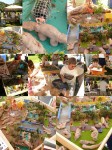
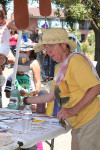
Well, well. well.  Things are start to take shape in festival land. I’m thinking we’ll be back down to around to around  40 exhibits this year which means they’ll be room for everyone to be on an interior lane. I think that will give the event a snugger feeling. Also lots of opportunities for folks to pass thru the middle and see Amy’s art progressing, so I’m okay with the smaller numbers.

Here’s my thinking so far…

Rick included me this morning  in an email about a beaver spotted in sunnyvale, our first ever. and this out by moffett gateway, (which btw was recently leased by Google, because of course there are beavers in Google!)

This photo courtesy of Romain Kain.

Sunnyvale beaver; Romain Kang

Yikes! Poor little disperser looking for his new home. I wonder how far he is from water? I wonder how many souls end up that way, looking for a start in life and a way to pay back student loans and find themselves trapped on a Google campus. Silicon Valley is a hard place to leave. I once called a tech about something ordered (a beaver bumper sticker) and the tech got quiet and then said carefully, “I think you might be my aunt!”.

(Which of course I was, one of my sister’s youngest daughter back then was working at Zazzle to help pay for her tuition. Small world. Now she’s working at that beaver campus.) I hope that little guy connects with water soon!

 Finally, a weird article this morning reminds us why beavers have to be careful around cars.

Roadkill Cuisine: Can You Eat That?

More than 300,000 animals are hit by vehicles in the road each year, according to a  study by the Federal Highway Administration, and the figure is believed to very under-reported. While an estimated 200 people die from these collisions in the U.S. every year, it’s mostly the wildlife that get the raw end of the deal.

Which brings us to the issue at hand. If you accidentally kill something on the road, can you eat it?

Beaver

If you’ve struck and killed a beaver, you should feel guilty. Once among the most widely distributed mammals in North America, beavers were eliminated from much of their range in the late 1800s because of unregulated trapping and loss of habitat, according to the California Fish and Wildlife. These brilliant engineers of the animal kingdom build dams and create wetlands that are among the most biologically productive ecosystems in the world, according to the Beaver Institute. Their ponds promote biodiversity, repair eroded stream channels, and promote salmon and trout recovery. Beaver is considered a game animal in some places, and there is no shortage of YouTube videos on how to cook it.

How is it that an article about roadkill says more nice things about beaver than most of the beaver articles we report on? Recognizing the difference they make for salmon and trout. Surely if The Street has enough time to dig up the info from the beaver institute, Jim or Becky in timber falls Wisconsin can do it when they write some article explaining why the city needs to trap them.

Right?


BEAVER FESTIVAL XVII

DONATE

Beaver Interactive: Click to view

TREE PROTECTION

BAY AREA PODCAST

Our story told around the county

LASSIE INVENTS BDA

CONTACT US

URBAN BEAVERS

LASSIE AND BEAVERS

Ten Years

The Beaver Cheat Sheet

Restoration

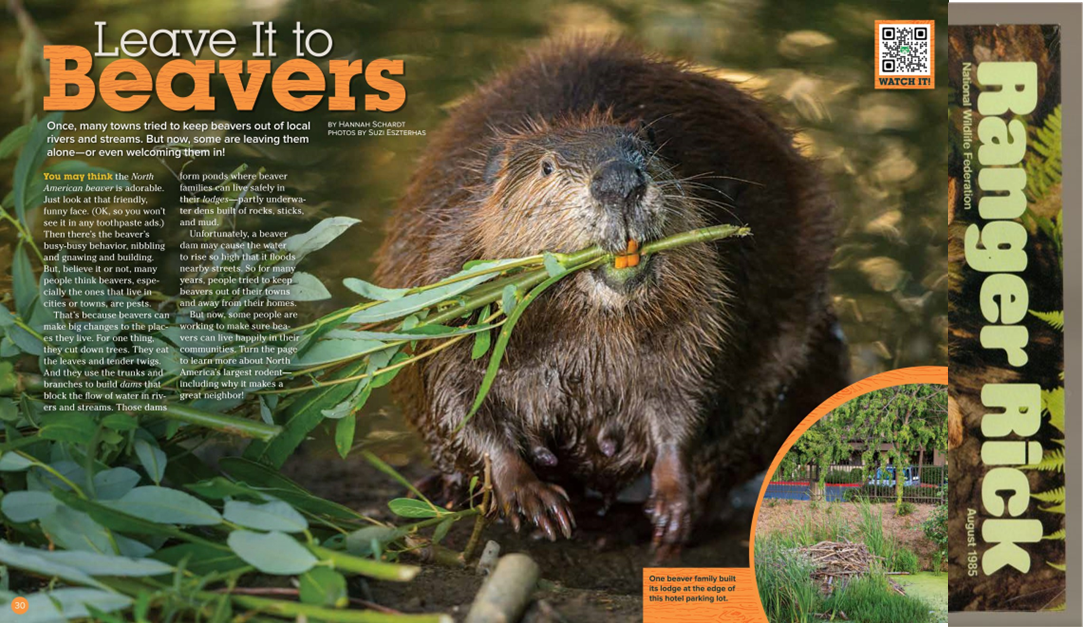
RANGER RICK

Ranger rick

The meeting that started it all

Past Reports

June 2026
M T W T F S S
1234567
891011121314
15161718192021
22232425262728
2930  

Story By Year