




Because the beaver isn't just an animal; it's an ecosystem!

Category: Beaver Behavior


FacebookFacebook
email articleemail article

You knew it would happen eventually. Harvard is going to study the MIT mascot and learn more about the dams they build. Not about the ecology they create mind you, just about the nuts and bolts. Apparently it’s not been studied a lot because – are you sitting down? – beavers work at night when all the grad students are usually busy partying, downloading porn or writing bad poetry.

Dammed if They Do

Today the beaver thrives in many biomes throughout North America because of the animal’s ability to modify its environment to suit its needs. In the foothills of the Rocky Mountains, where the Blackfeet nation is located, annual floods wash out beaver dams every spring allowing a unique opportunity to watch the colonies rebuild them from scratch. When Kennedy returned to this region as a graduate student she had a simple question: How do beavers build dams? To her surprise, there was relatively little research on the topic—particularly from the perspective of an engineer rather than a naturalist.

“Beavers can transform an ecosystem thousands of meters in length over a single summer,” she says. “Dams are only a small part of it. They need extensive trail networks so that they can travel back and forth to support material transport for lodges, dams, and food cache construction. They also excavate extensive canals and fell trees right alongside so that they can float them back to the dam. It’s a pretty sophisticated and large-scale engineering project, particularly when you consider that we’re talking about rodents only as big as a mid-sized dog.”

The kind of indirect coordination between animals based on environmental cues that Kennedy describes is called stigmergy. A termite, for instance, digs up some soil and leaves pheromones on it, which attracts another nestmate who does the same. Multiply by a million or two termites and you get a mound nearly three meters high. In her research, Kennedy explores whether stigmergy applies to beaver behavior.

Hmm that’s actually interesting. Here in old Martinez we got to watch beavers build dams directly, because our internet was down I guess and we went outside. And we saw beavers learn to build better. Beavers who were very bad builders. And beavers who improved over time. Whether they got better because of STIGMERGY I cannot say, but I do think that if you put a stick in a certain place and it was the wrong place the water will come and show you why. Especially when the creek is tidal and the water comes twice a day. Hey did you know Jordan attended the California Beaver Summit? Yes it’s true.

Around here we call it STICKMERGY!

Beavers are not termites. Besides being much larger and smarter than insects, the mammals’ works take much longer to construct than a termite mound. Moreover, beaver building behavior is not a response to pheromone cues. But Kennedy believes that beavers respond to the flow of water similar to the way that her mentor Mahadevan found termites respond to temperature and the flow of air. While it’s long been suspected by researchers that the sound of running water is a trigger for dam building, though, Kennedy says the reality is likely more complicated.

“If it was just that they hear running water, then beavers would be trying to build across Niagara Falls,” she says. “Other environmental factors work together to create a kind of ‘Goldilocks zone’ where things are just right and beavers are going to build.”

“I took measurements and you can see that, when the flow of water is sufficiently low enough, beavers will start building dams,” she says. “So, although my field sites were all more or less in the same location—all on Blackfeet land—beavers started building at different times depending on the flow rate I measured at their particular location. I think the data set shows that flow is a very strong trigger.”

Okay I guess you can say the water is operating like the pheremones here and stimulating more building or different building, but just remember that beavers in rehabilitation who have been raised from orphans are constantly “Building dams” our of their caretakers rainboots or newspapers or coffee cups. Building dams appears to be somewhat hard wired. The water teaches ways it could be better.

And the beaver LEARNS.

Kennedy’s findings address a much larger question: How big can a stigmergic system get? Her other faculty mentor, Fred Kavli Professor of Computer Science Rhadika Nagpal, has leveraged research on social insects to develop kilobots, “a low-cost, easy-to-use robotic system for advancing development of ‘swarms’ of robots that can be programmed to perform useful functions by coordinating interactions among many individuals.” A reflection of the insects that they imitate, however, kilobots are quite small—only about 33 millimeters in diameter. Beavers are orders of magnitude larger—as are their works.

“Yes, beavers cut down the trees, but then they bring in all this other plant life,” she says. “A number of papers demonstrate that plants start to flourish and invertebrates start to populate the areas beavers inhabit. Even if you don’t think that beavers are sacred, it’s coming more and more to the forefront how important they are to the health of our waterways and everything that lives there.”

Sure. That’s why I’d go to Yale to study beavers. Not to understand how they improve the environment; Or to learn how their decimation lead to historical and environmental ruin. Or even the destructive of biodiversity in early America or see if they help fight fires or end drought. I’d study beavers to learn if they can inform robotics. Because that that smells like funding to me.

Sheesh.


FacebookFacebook
email articleemail article

The Daily Mail is generally despised and regarded as half a rung above the National Inquierer, but sometimes they do post fun articles about beavers for some reason. I guess when there’s no royal behavior to speculate on.

Nice gnawing you! Huge beaver is captured in Utah after chewing through tree that fell into power line and left 1,000 homes without power

A power outage that left 1,000 people in a small Utah town in the dark this weekend was caused by a huge beaver who gnawed through a tree and sent it crashing into power lines. 

Nearly 1,000 residents of Logan were left without power for nearly an hour on Sunday afternoon  after a large tree landed on powerlines. But the tree had help falling down and in a letter to the mayor, a safety officer confirmed a particularly large beaver was the behind the outage after gnawing through the base of the tree, causing it to tip over.

In a Facebook post addressed to the city’s mayor, safety officer Brody Parker confirmed that a beaver, located between the Boulevard and Canyon Road, dropped a large tree that landed on the power lines.  After helping clean the trees and clear the area on Monday, Ambrie Darley, the Human Resource Director for the City of Logan, captured the animal on Tuesday, Parker wrote. 

Is that a really a HUGE beaver? It’s weird because he seems to be just the right size for the cage she happened to bring. Funny they would bring such a large cage for beavers that are, everyone knows, much much smaller.

Good thing they caught that great big TREE CHEWING beaver. The other ones won’t present a threat to the power lines I’m sure.They probably just eat daisies or something. Did someone tell the mayor that Logan Utah is famous for coexisting with the beavers that settled in Walmart property?


FacebookFacebook
email articleemail article

The late summer rabid beaver story. We get them every year, and it’s truly impossible to know whether they arise from a truly rabid beaver OR a beaver protecting it’s young that are born in the summer, Surely we never ever hear about rabid beavers in the winter or spring. But then no one usually wants to swim then either.

Lucky to be alive: 73-year-old Greenfield man mauled by beaver

GREENFIELD — A 73-year-old Greenfield man is recovering from injuries suffered when his leisurely swim in a remote Franklin County pond turned into a life-or-death fight with an enraged, and likely rabid, beaver.

Mark “Pres” Pieraccini suffered extensive injuries in the Sept. 6 attack, and came close to drowning. He had multiple puncture wounds, flesh torn from an arm and a leg, scratches and lacerations over his body and scalp, and a torn tendon on one of his fingers. He also has a fractured knuckle on one hand, mostly likely from punching the beaver as it repeatedly attacked him.

He is also undergoing treatment for rabies.

In an interview with The Republican, Pieraccini said fighting a prolonged battle with an enraged 50-pound wild animal while trying to stay afloat left him exhausted. While the fight continued in the deep water — he estimated it lasted five minutes — it occurred to him that he was in deep trouble.


They man doesn’t want to say which beaver pond because he likes beavers and doesn’t want  Mass Wildlife to kill them. So he’s clearly not a threat. But I myself spent 10 years of lazy mornings and evenings in very close quarters with beavers and their young and never felt in the least in danger.

Still when you think of what a tree looks like after beavers chew on it his leg doesn’t look that bad.

He said the doctors and nurses at the emergency room didn’t really grasp what he was saying when he told them he had been attack by a beaver. And then he took off his clothes to reveal the full extent of his injuries.

“No one had any clue what I was dealing with until I took my clothes off,” he said.”

Based on his research, Woodard said there have been just 11 attacks by beavers on people in North America over the last 10 years. In comparison, there have been 445 shark attacks, seven of them fatal, in the U.S. over the same period.

Most of those 11 beaver attacks involved beavers that were rabid. Woodard said he has no doubts, based on Pieraccini’s description and on the extent of his injuries, that his beaver was also rabid. The beaver has not been recovered, so there is no way to verify it.

The sad thing for the beaver of course is that every beaver in it’s family will soon be rabid too. Unless a rabid beaver is too crazed to swim home in the morning. In which case one or two might escape.

There’s more this morning, from Canada,

Not-so-docile animals: Angry beavers

Having lived an outdoor lifestyle for most of my life, I have come across a wide assortment of animals in distress. I once saved a baby pronghorn that misjudged the height of a barbwire fence, and a similar situation with a doe mule deer that had both hind legs tangles in the wire.

Lately, I have been seeing some very disturbing reports about beavers. My relationship with the beaver goes way back to my childhood and ranch days with my grandparents.

We had several creeks that flowed through our little ground. The water was very important to us, but for different reasons. My grandfather wanted the water to flow, free of obstructions, and irrigate his hay fields, so he could make money to keep us in daily gruel. I wanted the creeks for fishing.

The beavers dammed up the creeks, making wonderful ponds that held many trout. I would wade these ponds amongst the many beavers, and they basically ignored me. They never attacked me or threatened me for that matter. We maintained a very equitable relationship. They made ponds for me to fish in, and I kept the information from my grandfather, lest he blow the ponds, much to the dismay of the beavers and me.

So far so good, Some fond memories of swimming with beavers on the farm and fishing in their ponds. We like this story so far,

Science tells us that beavers can be very aggressive when defending their territory against interlopers. They might also attack humans when infected with rabies, although it is rare for a beaver to become rabid. There is also some thinking that beavers can become disoriented during the daylight hours and attack out of fear.

I have never found a beaver to be aggressive. I have walked up next to them, fished alongside of them, and watched them work on a pond for hours, never having one display any type of aggressiveness towards me. Perhaps that is about to change.

A 60-year-old fisherman in Belarus (a landlocked country in Europe) died when he was attacked by a beaver. The beaver tore open an artery and the man bled to death.

The media described the incident as “the latest in a series of beaver attacks on humans in the country.” Authorities claim the beaver was rabid, while others stated the man grabbed the beaver in an attempt to take a picture with it, hence the marshmallow and bison outcome.

Here the author does a fair job of walking through the famous beaver stories in the past few years, all cases of rabies or very very poor judgement. Or both.

Then he says something I truly enjoyed, Make sure you read this closely.

I am not sure if the beavers are seeking reparations for the years of trapping, they endured or if they hate kayaks. In either event, I am going to start keeping a closer eye on them when I am fishing a beaver pond. They may still be angry about the way my grandfather used to blow their ponds with dynamite.

Yes, Yes they are, I am too. Watch yourself around us buddy.

Photo by Mike Digout Saskatchewan

FacebookFacebook
email articleemail article

One LUCKY BASTARD!

That’s what I’d call him, Problem is he’s in Maine and all the smart people are on jury duty this week, or something. He simply can’t find a SOUL who know’s what he should do except kill em,

Battle with the yard-wrecking beavers takes an unexpected turn

Nobody really wants a family of beavers to take up residence in their backyard. At least, that’s what I’m coming to understand after just such a thing happened to me. The responses I’ve received since sharing my tale of woe a week ago have largely fallen into the vein of “trap ’em,” “whack ’em” or “hire someone to trap ’em and whack ’em.”

Of course, most of those responses came from a group of my friends who are a bit more unforgiving toward unwanted wildlife invasions than your group of pals might be.

A couple of others reached out to tell me that they had other ideas. The basic flavor of those responses: When life gives you beavers, make — well — arts and crafts, I suppose.

The article is written by John Holyoke of the Bangor daily news. He’s a sports and outdoor columnist so you would think he would appreciate having better fishing and duck hunting on his property, not to mention clean water and fire protection. But what do I know?

But back to my current beaver issue. Since my tree didn’t fall on the house, I’m reluctant to call the situation a “problem.” Yet.

After noticing the fallen tree and its beaver-chewed neighbor, I deployed a trail camera recently and have been eagerly waiting for more evidence of beaver activity that I could share with you. Unfortunately, according to my less-than-scientific beaver-o-meter, it doesn’t appear that the still-standing tree has taken any more mega-bites over the past eight days.

Or, I guess, I meant to say “fortunately.” Not that this tree is long for the world, mind you — Bucky has already reduced it to a leaning tower of birch that (again, fortunately) is tilted away from the house.

Still, I knew you’d love to see a video of my (current) nemesis (see also: red squirrels, moose, deer, et al.), so I had hoped to have had better luck.

That’s not to say that I had no luck at all, mind you.

I did get a great video of another critter visiting the scene of the beaver’s property crime. And when I first watched the video on a small thumbnail screen, I was quite certain that I’d captured footage of the world’s most acrobatic and agile beaver.

Unfortunately (or is it fortunately?), my visitor was only a gray squirrel. And fortunately (or is it unfortunately?), the squirrel showed no interest in helping the beaver chew down the rest of my tree.

Poor man doesn’t even know where to put a camera, Do you have any water on your property? maybe a dam or a lodge? If all you have is a single tree that got chewed I’d say too bad, all you have is a beaver drive-by which gives you time to read up on how lucky you’ll be if they ever come back. i have just the book.


FacebookFacebook
email articleemail article

You know beavers must be like those kids that everyone knows and everyone counts among their their closest friends. I’m sure they get invited to all the birthday parties. But whether any of us will be on their guest list remains to be seen.

[wonderplugin_video iframe=”https://youtu.be/uJ7tx7s99H4″ lightbox=0 lightboxsize=1 lightboxwidth=960 lightboxheight=540 autoopen=0 autoopendelay=0 autoclose=0 lightboxtitle=”” lightboxgroup=”” lightboxshownavigation=0 showimage=”” lightboxoptions=”” videowidth=600 videoheight=400 keepaspectratio=1 autoplay=0 loop=0 videocss=”position:relative;display:block;background-color:#000;overflow:hidden;max-width:100%;margin:0 auto;” playbutton=”https://www.martinezbeavers.org/wordpress/wp-content/plugins/wonderplugin-video-embed/engine/playvideo-64-64-0.png”]


Wyoming Beaver and Moose Chow Down Together in Grand Teton

It’s not exactly breaking news that wildlife in Wyoming has to compete for food sources. However, a recent video share proves that at least moose and beaver can peacefully coexist as that’s exactly what happened in Grand Teton National Park.

One of the tour groups that takes visitors through Yellowstone and Grand Teton National Parks shared this quaint moment recently.

Nice to hear a tour guide saying the right thing about beavers.

Their video share was more than just a neat wildlife moment. They added a key mention about why beavers are key to many types of animals that I didn’t realize:

Beaver dams Stop, Slow, and Spread water to the benefit of numerous plant and animal species.

In effect, beavers in Wyoming create a wetland habitat that helps with the growth of plants and other edible sources that help wildlife like moose and deer which in turn helps bears and wolves.
One YouTube comment asked if this was captured near Schwabacher Landing in Grand Teton National Park. There’s no way to tell for certain, but that is one the locations where you can get an iconic pic of Grand Teton.

If nothing else, this moose and beaver moment shows that wildlife can and do get along as one animals manipulation of the habitat helps many.

Yes, And that animal is called a BEAVER, and whenever you trap them or hunt them or depredate them you ruin the habitat for many.

Just sayin’.

DONATE

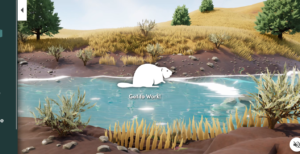
Beaver Interactive: Click to view

TREE PROTECTION

BAY AREA PODCAST

Our story told around the county

LASSIE INVENTS BDA

CONTACT US

URBAN BEAVERS

LASSIE AND BEAVERS

Ten Years

The Beaver Cheat Sheet

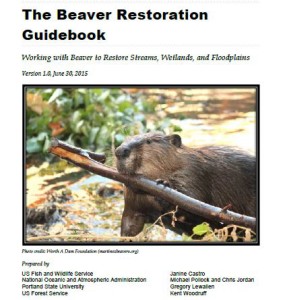
Restoration

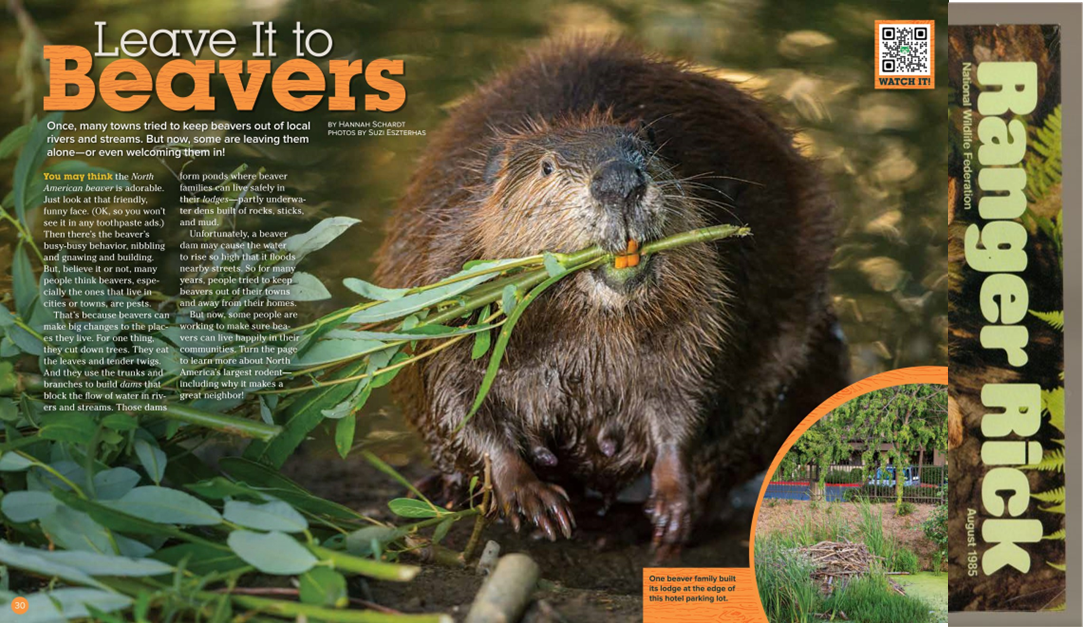
RANGER RICK

Ranger rick

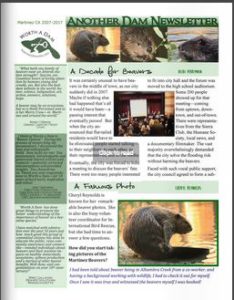
The meeting that started it all

Past Reports

October 2026
M T W T F S S
 1234
567891011
12131415161718
19202122232425
262728293031  

Story By Year

close

Share the beaver gospel!