




Speaking of trees, Judy Atkinson of Port Moody wrote yesterday about an idea she was trying to finalize for how to talk to people about the trees beavers felled. She noted the people seemed to get anxious about beavers ‘killing’ everything and was working to replace the concept with language emphasizing transformation instead.
The trees aren’t being hauled off by a contractor or the municipality, they are still there in the wetland, but either laying at an angle, laying on the ground or sitting in the water. Each one of those places is important for the wetland and the wildlife.
If a beaver felled tree falls in the pond it adds nutrient to the water, raising the complexity. These trees make shaded, safe spots for fish to hide. If the tree falls at an angle and becomes a snag, mother ducks and their ducklings roost on the trunk at night for safety. Trees are vital to wildlife even when they are dead or dying. If tree that doesn’t like wet feet drowns, it becomes a nature tree for cavity dwellers.
I could see what she was getting and why it was important. I reminded her to educate the city workers too and make sure they LEFT the fallen trees in the first place. I suggested she might want to introduce some kind of interpretive sign to help observers understand what they were seeing. Something like
“Pardon our disarray while we rebuild the ecosystem”
She like the idea very much and we were both surprised to find that with no input from us, the Rugged Individualist dropped a third post, dedicated to that very topic.

The Paradox of A Rotting Forest
Dead trees are essential in more ways than this brief article can cover. They are in many regards the lifeblood of the forest, just as important as their living brethren. They are a natural part of a dynamic environment in which all trees age and eventually die….We need to reconsider these integral and indispensable parts of the forest for what they are.
Let us start with dead trees as the irreplaceable substrate for woodpeckers to perform their role as an integral keystone species. Woodpeckers, like beavers, perform functions that have a disproportionate effect on the ecosystem they live within and the species that reside there. When a dead or dying tree is left to the forces of natural processes, it attracts bug life that utilizes the weakened internal structure. This is the impetus for woodpeckers to hammer into the tree, seeking out the cloistered invertebrates. What is left over after the woodpecker’s persistent chiseling are cavities that serve as homes, both permanent and temporary, for an astonishing array of wildlife. Small mammals, like squirrels, raccoons, opossums, martens, fishers, and bats, take advantage of the woodpecker’s hard work. This hard work is just as cherished by the 40 or so (probably more) different bird species in North America that cannot excavate their own cavities and rely exclusively on woodpecker borings for suitable homes. These birds range in variety from songbirds to wood ducks to raptors.
I’m sure you get the idea, and AJB describes it very well. Too often people look at beaver activity as destruction, when what it really is is TRANSFORMATION. Remember, that which a caterpillar calls the end of the world, the creator calls a butterfly.
It’s hard in today’s supremely flammable world to convince people to leave dead wood anyway on a property. My parents home in the sierras was told they would lose their insurance carrier if they did not removal all wood, trees and leaves within 500 feet of the dwelling. I can imagine well that one of the unintended effects of climate change is that as people get more afraid of fire their is less dead or decaying wood left around which induces a trickle down of negative effects for insects, cavity nesters and hungry wildlife.
Dead trees don’t just need the expert craft of a woodpecker to provide refuge, though. Depending on the size, trees produce large, natural cavities capable of supporting creatures from rodents to bears. Not only are they directly beneficial to certain species as shelter, many of these species are prey creatures that support predators. Unfortunately, there are a very limited number of trees remaining that are of a size to produce large cavities caused from internal decay. In fact, this is so drastically true that according to a study by Frontiers in Ecology and The Environment, 99% of the cavities in North America used by birds and small mammals are created by woodpeckers.
And what about the trees beaver fell?
Downed trees lying prostrate on the ground provide plenty of moist, decomposing detritus. This is where severely imperiled amphibians like salamanders, frogs, etc. can find protection and sanctuary. The stumps that may remain if a dead tree snaps usually retain an intact root system that provide lodging/hibernacula for many species. Downed trees in and around water sources serve as crucial basking sites for turtles, snakes, and more. Dead trees, standing or fallen, are a treasure to our herpetofauna that can be the difference between preservation or total collapse of populations.
So the next time you start complaining about all that ‘destruction’ beavers are doing on your land, try thinking about it as transformation. Beavers change things. It’s what they do.


 Beavers have chewed their way through trees at Twin Lakes Recreation Area — including some planted as memorials for loved ones. Families have paid $250 each for these trees to memorialize family members or friends and work colleagues who have died.
 Beavers — Wild Earth Guardians
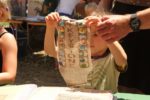
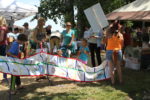
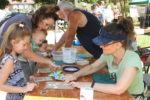
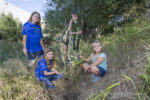
 So, when the opportunity came up in late September to be a beaver for a day with WildEarth Guardians’ restoration crew, I jumped at it—especially since I could bring along my energetic, six-year-old twin boys.
 Absent cows, there would be willows along the stream. And almost everywhere there are willows, beavers thrive. And where beavers thrive there is ecological dynamism, and the land sings, with the literal songs of flycatchers and frogs and with the slithering of snakes and the pattering of shrews and mice. And in the stream itself, native trout grow fatter and more abundant in the cooler, deeper waters that beaver dams create.
 I mention this because in the back of my mind I tend to think of the days before the annual Worth A Dam ravioli feed as Degrees of Freedom. As in “There are this many chances to get it wrong or forget a detail or have to take someone to the ER and still achieve the desired result.” The closer we get to day, the room for error gets lower and lower. As of this morning there is one day left before our 5 course dinner for 13 people. That means one day to get the house set up and make sauces ready and dip the cookies in chocolate. If we were visited by unexpected relatives today, or broke someones toe or had a power outage – tomorrow would become nearly impossible.
 During the last week of December, I skied down to look for the beaver that recently moved into the brook below my house. Beavers do not relocate in December unless calamity strikes. I suspected that a raging torrent from rain and snowmelt had destroyed this beaver’s dam and washed its food cache downstream. While this new location offers good foraging, the rocky stream bottom provides little mud for sealing a dam. Without a deep pond, ice can seal the entrance to a beaver’s lodge, trapping the beaver inside.