
For reasons I don’t understand I received notice of this video yesterday, which was apparently posted originally in 2015. I assure you that if I had ever known about it I would have shared it right away and of course sent it wrapped in a big red bow to Ted Williams, but I just found out about it. I can’t imagine what rock I was hiding under that I missed it, (although 2015 was a spectacularly bad year, what with all the kits dying and all.) Not to mention it was originally published three weeks before I was retiring my entire clinical practice and closing out 30 years of files, so I might have been a little busy.
 Anyway its a remarkable short film, well worth 5 minutes of your time. Patient filmmaker and Associate Professor Andrew Hendry did an amazing job of capturing the salmon experience, although he can’t help but stick a hand in to rescue a fish or two. Dr. Hendry is a fisheries biologist who teaches at McGill University in Montreal, but was actually born in nearby Woodland California!
His specialty is ‘eco-evolution’. Here’s what it says on his faculty page.
Andrew Hendry
Darwin suggested that evolution proceeds very slowly, and this view was almost universally accepted until the later part of the 20th century. Over the past few decades, however, a dramatic shift has taken place toward the idea that ongoing evolution is occurring all around us; so-called “rapid” or “contemporary” evolution.
Now that contemporary evolution is widely accepted as a commonplace occurrence, a number of researchers have become interested in its consequences for ecological dynamics; i.e., changes in populations, communities, and ecosystems. This idea has been incorporated into the developing field of “eco-evolutionary dynamics,” broadly considers ongoing interactions between ecology and evolution. Most of our work to date has focused on one direction of causality in these dynamics – how ecological changes influence evolutionary dynamics (eco-to-evo). More recently, we have started to explore the reciprocal arrow of causality: how evolutionary changes influence ecological dynamics (evo-to-eco). We conduct work on both arrows of causality in multiple natural systems, most frequently in lake versus stream stickleback, high-predation versus low-predation guppies, and Darwin’s finches.
Pretty darn interesting to see a fisheries biologist who films salmon jumping over a beaver dam. Just GUESS here he got his Ph.D..
Go ahead, guess!
Aren’t you exhausted just watching those fish? Me too! That’s an incredible amount of effort to spend knowing they’re just going to die at the end! Come to think of it, maybe that’s one of the greatest parts about being a salmon. The complete lack of self-awareness so that they have zero idea of the futility of their mission.
I’m sure once humans figured out that they were going to die when they reached their original stream and spawned NO ONE w0uld ever go through with it. Even if the possibility of sex was guaranteed.
Self-awareness is an obstacle to evolution. Who knew?
 Imagine the life of a local salmon emerging from the protected shield of its egg into the fast-moving currents of the gorgeous, green Nooksack River. You evade predators, like adult fish, and your body is so small that you filter through wood and debris in the river for a year. Then you drift all the way down to Bellingham Bay. There, your gills adapt to saltwater and you remain in the ocean for several years.


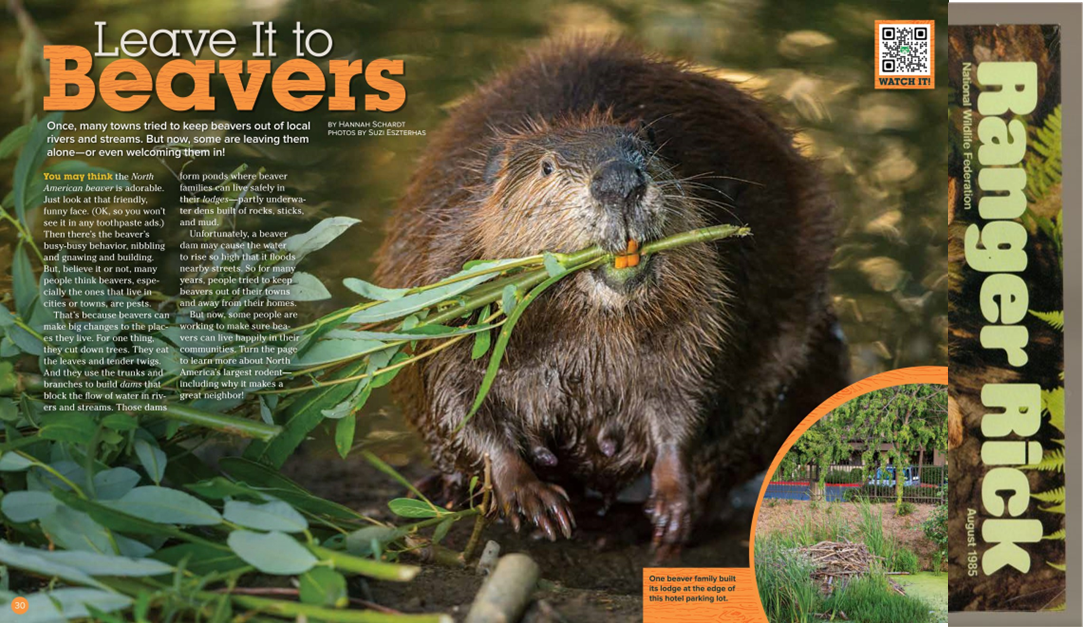
 To celebrate the 49th Earth Day on Monday, April 22, Wilton Wildlife Preserve & Park and Saratoga PLAN are teaming up to offer a nature walk that is all about the largest rodent in North America, New York State’s official animal; the Beaver!
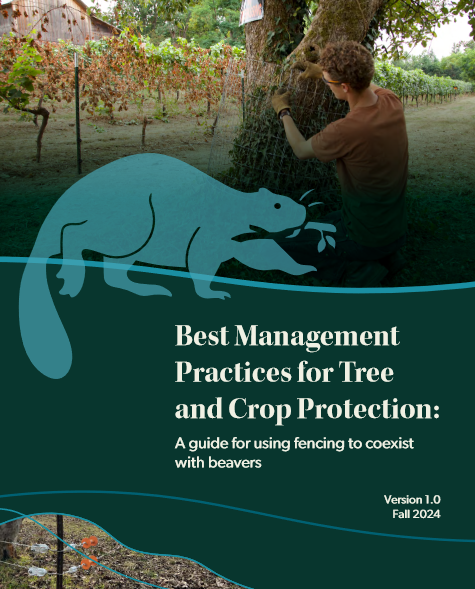
  Not sure yet of the best beaver-y way to celebrate your earth day this year? There’s an upcoming beaver management online course featuring Jakob Shockey of
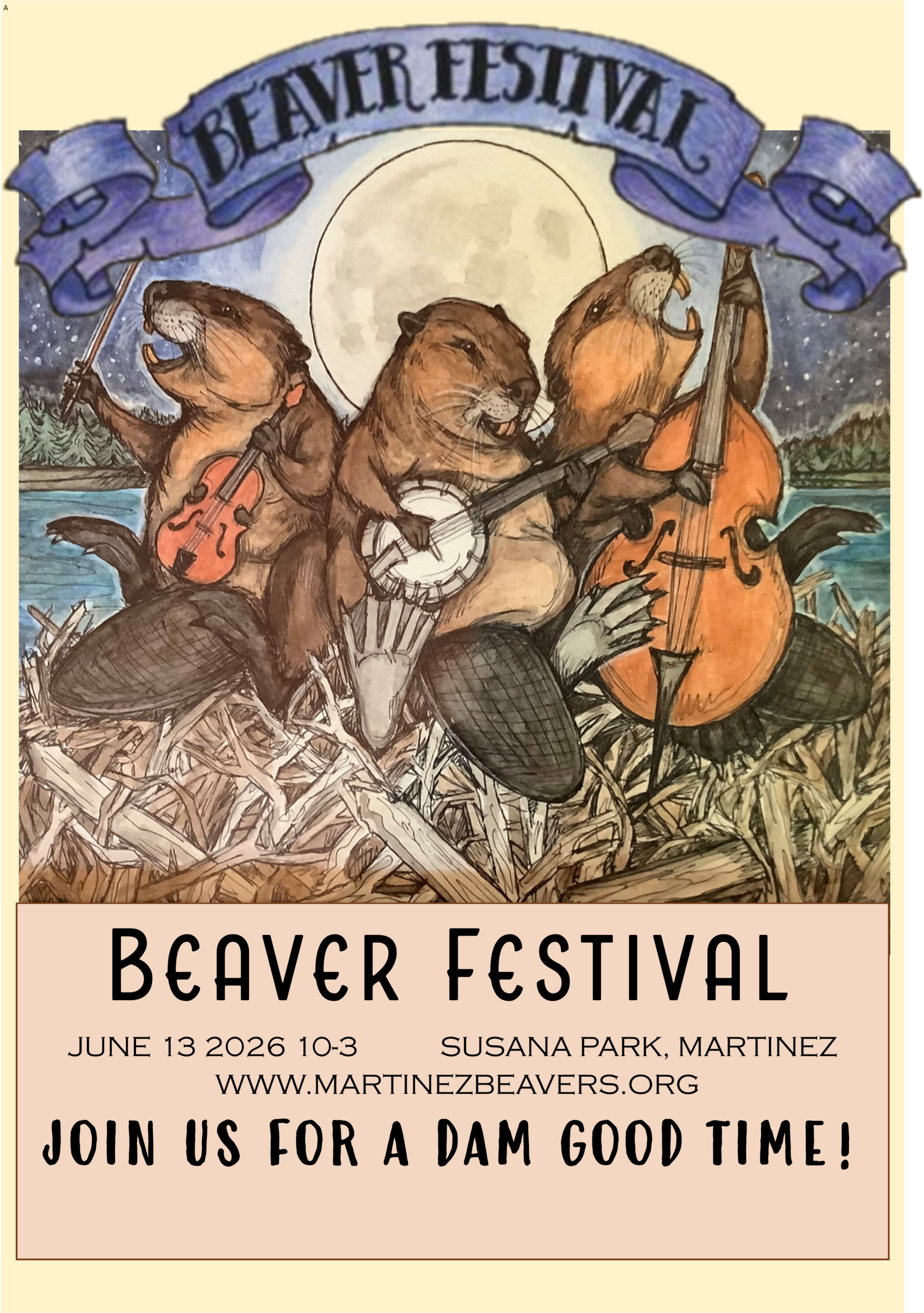
 Ben Goldfarb is in Colorado this week, and in Idaho last week. You would think that if a book was doing well enough to hock copies all across the beavered United States that the author would at least make it to Martinez for the festival, wouldn’t you?
 Learn all about beavers April 11

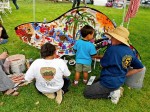
 Of course no American child lives past the age of 10 without having to play at least ONE game of “Simon says” – so I thought “Salmon sez” would be very familiar. There will be various beaver/salmon puppets hanging around the tent where kids are working and some images to get them inspired. This poster came out very cute so I think it will be on display as well.