



Today I have a pair of schizophrenic beaver news stories to ‘catch up on’. So we will go from the sublime to the ridiculous really fast,. Let’s start with north central Washington where beaver dams are considered SO helpful, a bunch of people are building them.
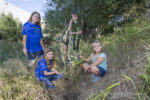
Human-built ‘beaver dams’ restore streams
 Beavers are a critical asset in Washington, assuring that healthy riparian zones are maintained, especially in the dry climate east of the Cascades. Beaver dams and ponds support native vegetation and wetlands along streams, trap sediment, recharge groundwater, and improve water quality. Over the last two centuries, these benefits have been lost in many watersheds, following human development, beaver removal, channel deepening, and other impacts.
n 2015, the Okanogan Highland Alliance (OHA) was awarded a grant to restore a reach of Myers Creek, through Ecology’s Water Quality Financial Assistance Program. In the 1990s, Myers Creek was damaged in a major rain-on-snow event, which caused unusually high stream flows, deepening the creek, leaving vertical cut banks, and draining nearby wetlands.
 Where beaver ponds had once provided grade control and covered large areas of the floodplain, the now-drier soils began to favor invasive plant species. The understory is now dominated by reed canarygrass (Phalaris arundinacea) and Canada thistle (Cirsium arvense), further suppressing growth of native sedge and forb species. The only remaining native riparian species still easily found in the project area is gray alder (Alnus incana), with a few isolated willow (Salix spp.) plants.
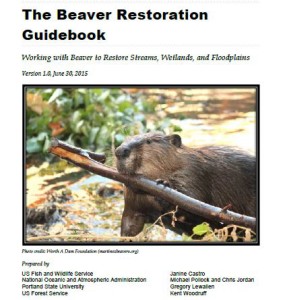
Developed by Michael Pollock (NOAA) and colleagues, BDAs offer a low-cost, simple, and easily scalable technique  for mimicking beaver dams. They reduce stream velocity, induce lateral channel migration, and cause rapid aggradation of the streambed, which reconnects the floodplain so it can once again support riparian vegetation.
The long-term vision for BDA projects is that beaver will once again maintain dams to provide local grade control, floodplain connection, and wetland habitats to support a diverse flora and fauna. Sometimes partners like the Okanogan Highlands Alliance, the Washington Department of Ecology, along with many others, just have to help give them the boost they need.
And if you try real hard the good fairy will make you a REAL beaver dam and you will get real beavers to take care of you with no grant funding needed at all! Amazing huh? Maybe these stories DO go together after all. Maybe it’s a reverse case of “Love the sinner hate the sin” kinda thing. Only what gets loved is the dams, and what gets hated is the hero that makes them.
Contrast this story with Martin county in Minnesota where they hate beavers SO much they are raising the bounty on their heads from 20 per trapped beaver to FIFTY,
County tackles gnawing problem
FAIRMONT — The beaver population in Martin County has been on the rise, causing no end of trouble for area farmers.
In December, Martin County commissioners increased the county’s beaver bounty from $20 to $50 per beaver, in an effort to alleviate the issue. According to drainage administrator Michael Forstner, this was necessary because of the low value currently in the market for the pelt.
Paul Grussing, a local trapper utilized by the county, explained the issue and was able to share some insight into the trapping process.
“The previous bounty was $20 for each beaver; at that amount it costs trappers money to trap them,” he said. “Trappers refused to trap them, resulting in a large increase in the population of beavers in Martin County. Traps and lures for beaver trapping are expensive, plus it is hard work.
“The population is quite high in our county, and beavers tend to build their dams in hard to reach areas. Most of my calls begin in September when farmers start their harvest. They see damage to their crops and dams being built.
You poor little snowflake, trapper Paul. Killing beavers is SO hard (and damp) and it’s winter ya know? Good thing you have the county supervisors by the short and curlies and can pry 50 bucks out of their palms for each beaver you take. That means you get several hundred per family. You’re RICH! Hmmm, come to think of it, maybe the bounty doesn’t count sub adults so you just leave the kits to die.
I really, really hate Martin County.
As far as Martin County is concerned, only beavers trapped within a drainage system or within one-quarter mile of a drainage system outlet will be accepted for the bounty,
And tell me, wise ones of Martin county, how, exactly, will you know?

 The smith canal takes water from the San Joaquin river in to the interior of Stockton to feed Yosemite lake just south of the University of the Pacific. It was originally created as a passage way for barge ships carrying or picking up agriculture to and from the region. It is now lined with homes and docks for pleasure boats. American legion park houses the old barge turn around point which is now called a ‘lake’ and lined with trees for recreation.
 e its course.

 But in following the Port Moody case, where they get a dusting of snow occasionally but the water never freezes, I’ve realized things aren’t entirely clear to me. The city reported that the photo of the beaver in the drain clearly showed it’s “food cache”. But why would a beaver need a food cache where it never freezes? And how would a food cache that’s above the water line be of any use if it did freeze?
 There aren’t may photos of food caches online, which I guess means that they are usually underwater or mostly underwater. But I was able to find a few. I suppose there are beavers in ‘in-between zones’ where it sometimes freezes or has occasionally frozen.
 his is Paul Ramsay’s photo of the beavers at Bamff where it also doesn’t freeze solid. You can clearly see the sticks. Clearly above water. Where it would be absolutely no use to them to have sticks if it did freeze solid. So what’s up with that?

 The famously busy mammals build elaborate homes, which are called lodges when they are in open water and very visible, says
  But they’re fine as long as they have an area to