
Because the beaver isn't just an animal; it's an ecosystem!

Author: heidi08

Heidi is a child psychologist who became an accidental beaver advocate when a family of beavers moved into the creek near her home. Now she lectures about beavers nationwide and maintains the website martinezbeavers.org/wordpress which provides resources to make this work easier for others to do.

Oregon’s good news is getting itself talked about. Nice report from OPB.

Oregon increasing beaver protections to help salmon, slow wildfires

Oregon just passed its second beaver protection law in as many years. The hope is that a bigger beaver population will help salmon, slow wildfires and also safeguard drinking water.

Ron Jackson has a 23-acre ranch outside of Prineville, Oregon. A little creek travels across it, attracting wild turkey and deer. And while he doesn’t see them very often, there are also beaver hiding in his wetland.

“They make a nice sharp point, cutting down our trees,” Jackson said. “And I see where they’ve taken the branches and made little dams.”

Beaver dams help keep the foliage under control. They also mean the water sits on his land longer and has time to seep into the ground. That brings up the water table, allowing plants to grow longer and keep things wetter, and thus also helps inhibit wildfires.

“Some of this stuff grows so wild, they’re doing me a favor,” Jackson said. “I don’t want to run them off, unless they become a huge pest. And they’re not.”

Keep the beavers you have so they can keep the others from moving in! That’s my advice.

Jackson is a retired pilot, so he can enjoy just watching the wildlife. He doesn’t have to make money off the land.

An hour away in Madras, Jeremy Watson traps beavers on an 83,000-acre working beef ranch. There are about six beaver colonies. Each one contains maybe eight beavers. Watson leaves four colonies alone because they’re not causing any problems.

But he’s regularly trapping at the other two.

“Where it is, it’s a crossing. And so (the water) blocks up the crossing and it washes the bridge out,” Watson said.

When beavers are trapped, it’s usually because they’re causing this kind of damage. Some are shot for sport. But the taking of any beaver in Oregon is becoming increasingly regulated, because so much money is being spent on bringing them back into Oregon’s landscapes.

After years of focusing on salmon, scientists are now understanding that beavers are very important for salmon. Beaver dams are thought do everything from cooling and cleaning the water, to providing deep pools for young salmon to live in, as well as helping to ensure there are bugs to eat and willows for shade and protection.

Suffer the little salmon to come unto us! No one who want’s salmon should be against beavers!

The Oregon Legislature has recently passed two bills that increase beaver protections. House Bill 3464 reclassified them as “furbearing” animals, rather than “predatory” animals. In practical terms, landowners must now get a permit to remove a problem beaver and they must report the removal to the Oregon Department of Fish and Wildlife.

“To me that’s a good bill,” said Watson, “because not everybody can just go shoot them now.”

Salem passed another beaver protection law this year, House Bill 3932. Its sponsor, Oregon Rep. Pam Marsh, said it protects beavers by restricting trapping along waterways on public land that are “impaired.” That is waterways that suffer from high temperatures, excessive sediment, low oxygen or high nutrient levels.

“There’s a lot of associated issues as to what’s going to turn around an impaired waterway,” Marsh said. “But what we know is that beavers can be a helpful element. So that’s what we’re doing.”

Of Oregon’s 300,000 miles of rivers, about a third are classified as impaired by the Oregon Department of Environmental Quality.

That’s a lot of water, said trapper Jeremy Watson, who thinks this new law goes too far. He said the law takes away an activity that Oregonians have participated in for generations.

“You’re taking these rights away on something that they’re saying is a problem, but it’s not a problem,” Watson said. “There is no shortage of beavers in the state of Oregon.”

Hush. Less trapping and more tail slapping!

Watson also said many beavers don’t actually help cool or clean the water — an issue that scientists are still researching.

But other people, like retired habitat manager Fran Recht, welcome the new beaver protection laws. She said she’s particularly appreciative of the way beavers protect drinking water with their dams and dampen the forest, helping to protect against wildfires.

Why do wrong people keep being wrong even though the solutions are obvious? Oh right. Didn’t Upton Sinclair have an answer for that?

“It is difficult to get a man to understand something, when his salary depends on his not understanding it.” -Upton Sinclair

“With the climate crisis and fires and droughts, we’ve got to get beavers back on the landscape,” Recht said. “And one of the big tools is restricting hunting and trapping.”

Recht is against trapping primarily because it happens during the pupping and mating season. That makes it hard for beaver populations to grow.

Many people also don’t like the fact that when beavers are trapped underwater, if they’re not killed instantly, they slowly drown.

While environmentalists and trappers disagree on some issues, there appears to be a consensus that what Oregon really needs is more beaver habitat. There are lots of efforts to create it by building artificial beaver dams across Oregon.

Chris Gannon, who directs the Crooked River Watershed Council in Prineville, said creating beaver habitat is not as easy as it sounds. He said it can take up to 10 years for an artificial beaver pond to grow the vegetation needed to support an actual beaver.

“It took a long time for these systems to degrade. It took a long time to trap beavers and virtually drive them to near extinction,” Gannon said. “So it’s going to take some time to bring them back to any kind of significant numbers.”

Meanwhile, the Beaver State’s eponymous animal seems to be enjoying a moment.

Beaver protection ideas continue to circulate through Salem, and the Oregon Department of Fish and Wildlife’s beaver commission is several years into its Beaver Action Plan.

Protect beavers. Protect salmon. Protect ourselves.
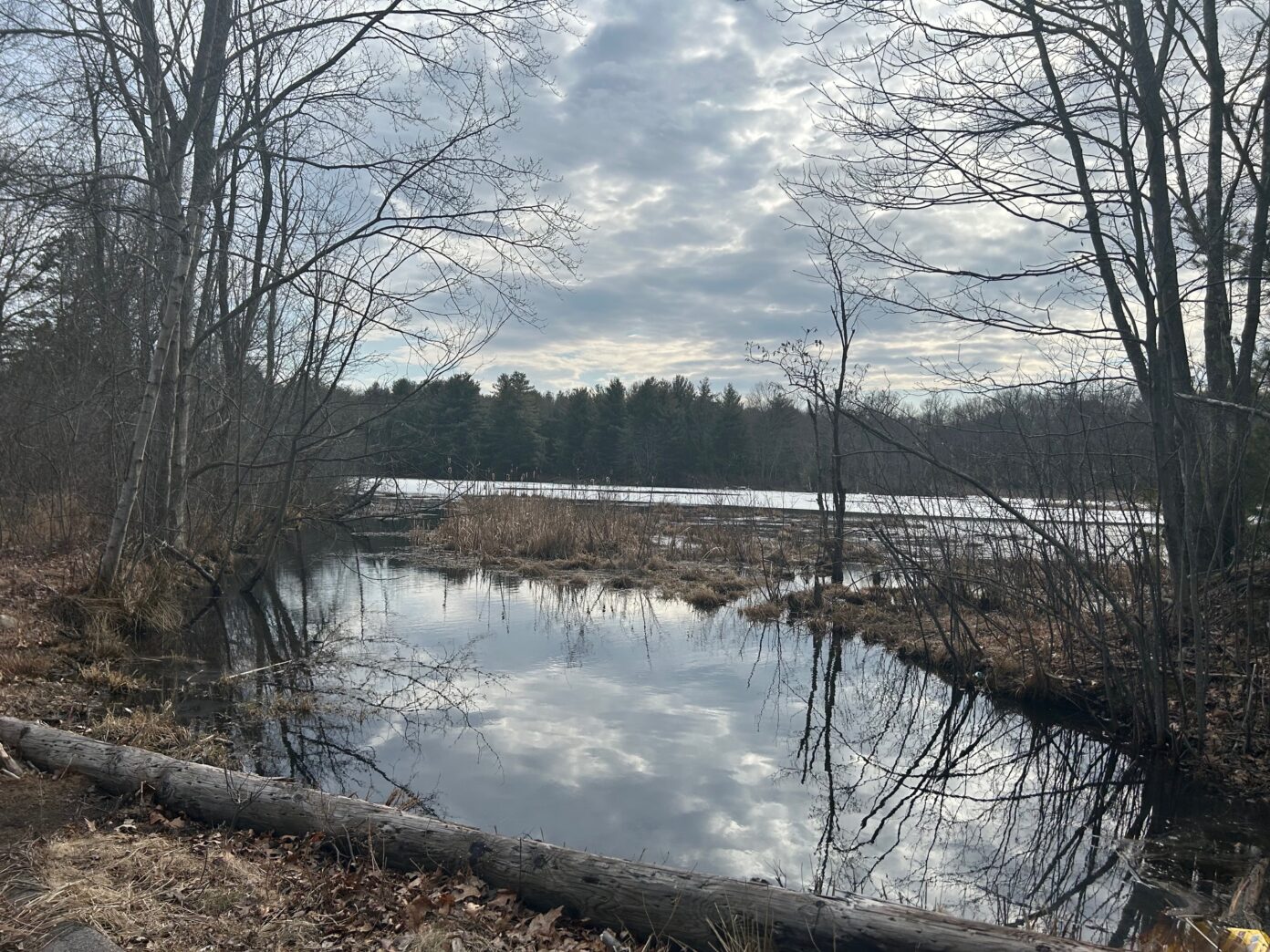

I’m a sucker for any city council where humane solutions for beaver are discussed. And this recent article from Rhode Island got all my attention.

Councilor calls for humane solution to beaver troubles on Mechanic Street

NORTH SMITHFIELD – A dam built – and then rebuilt – by beavers has caused ongoing problems with flooding on Mechanic Street and now, one town councilor is asking North Smithfield officials to pursue a humane solution.

Councilor Rebecca DeCristofaro has asked Town Administrator Scott Gibbs to look into using a beaver diversion device rather than the usual practice of euthanizing the critters.

“If this is an issue in town, then maybe a diversion plan is a better solution than just having to kill beavers year after year,” DeCristofaro told Gibbs at a meeting last week.

When I read a sentence like that I realize that it truly is a new world we are living in for beavers. Once upon a time I heard from our city treasurer that she happened to see a documentary about Skip Lisle and beaver deceivers and invited the mayor and public works over to watch it at her house when we were in the middle of the beaver drama.

Do you think they came? GUESS.

Much simpler than it sounds, a “diversion system” is essentially just a pipe through a beaver dam that allows water to flow past. Dams can be a troublesome – and often reoccurring – nuisance as the animals work to block water flow, causing build up that floods yards and roadways, and can result in costly damage.

“It’s a horrible problem,” said Gibbs. “They’re very destructive. I understand the sensitivity, but I also understand when people’s driveways are collapsing from flooding, that makes me a little bit anxious.”

It is not the first time the town has debated potential solutions to beaver troubles. Multiple diversion systems – also known as beaver deceivers – were installed at a town-owned property known as Cedar Swamp under the guidance of former Conservation Commission Chairman Paul Soares between 2014 and 2018. Paulette Hamilton was serving as town administrator at time, and recalls the discussions and eventual solution.

“Beaver diversion systems were not really that popular then,” Hamilton said. “It’s a very, very small investment for a long term solution to a problem.”

At the time, the systems cost around $1,200.

Come on people. Skip is 157 miles away. Martinez brought him out THREE THOUSAND MILES. We took a much bigger risk than you. N

Much simpler than it sounds, a “diversion system” is essentially just a pipe through a beaver dam that allows water to flow past. Dams can be a troublesome – and often reoccurring – nuisance as the animals work to block water flow, causing build up that floods yards and roadways, and can result in costly damage.

“It’s a horrible problem,” said Gibbs. “They’re very destructive. I understand the sensitivity, but I also understand when people’s driveways are collapsing from flooding, that makes me a little bit anxious.”

It is not the first time the town has debated potential solutions to beaver troubles. Multiple diversion systems – also known as beaver deceivers – were installed at a town-owned property known as Cedar Swamp under the guidance of former Conservation Commission Chairman Paul Soares between 2014 and 2018. Paulette Hamilton was serving as town administrator at time, and recalls the discussions and eventual solution.

“Beaver diversion systems were not really that popular then,” Hamilton said. “It’s a very, very small investment for a long term solution to a problem.”

At the time, the systems cost around $1,200.S

I remembered that our city council was so alarmed by the scary beaver people that they had 11 police officers and a sniper at the beaver meeting.

I didn’t find out about the sniper until a decade later.

“I was very, very much against euthanizing,” said Hamilton. “It was a last resort.”

While the state suggests euthanasia as a means to deal with nuisance beavers, Hamilton noted it often doesn’t solve the problem.

“Others will come in and they’ll start using the same area,” she said.

“They really do a lot of good stuff,” said Hamilton.

On Mechanic Street, beaver dams on a 27 acre property purchased this year by Mike Mongeon of North Smithfield Tree Service has caused flooding that has damaged an abutting driveway, which has started to develop a sinkhole.

“It’s been flooding into the roadway,” said Gibbs. While town officials are actively working with the owner on a solution, Gibbs noted, “We do not have the legal right to go onto a private property and expend public funds.”

And is the creek private property? Because that’s where the flow device would be.

Gibbs noted the flooding is not a new issue and that town officials also worked with the past owner.

“This problem has resurfaced on numerous occasions,” Gibbs said.

DeCristofaro told NRI NOW this week that she’s serious about the issue. During the last council meeting, she told board members she would gladly relocate the animals to her own property if it wasn’t illegal in the state.

“I obviously love animals,” DeCristofaro said. “I have a whole farm.”

Gibbs said he’s hopeful a solution will be found.

“As the town administrator, I lean more on the rights of property owners than the beavers though, and it’s causing some serious property damage off of Mechanic right now, and it’s got to be resolved, he said. “We’re working carefully around this issue. The DPW director is looking at diversion as a possible option to mitigate the problem.”

If there’s a will there’s a way. Our story proves you can truly do this and there are good reasons why you should. I have gotten out of the habit of writing letters to cities with beaver issues but maybe I can do one more.

For the team.


Carolina Wildlife Conservation Center 

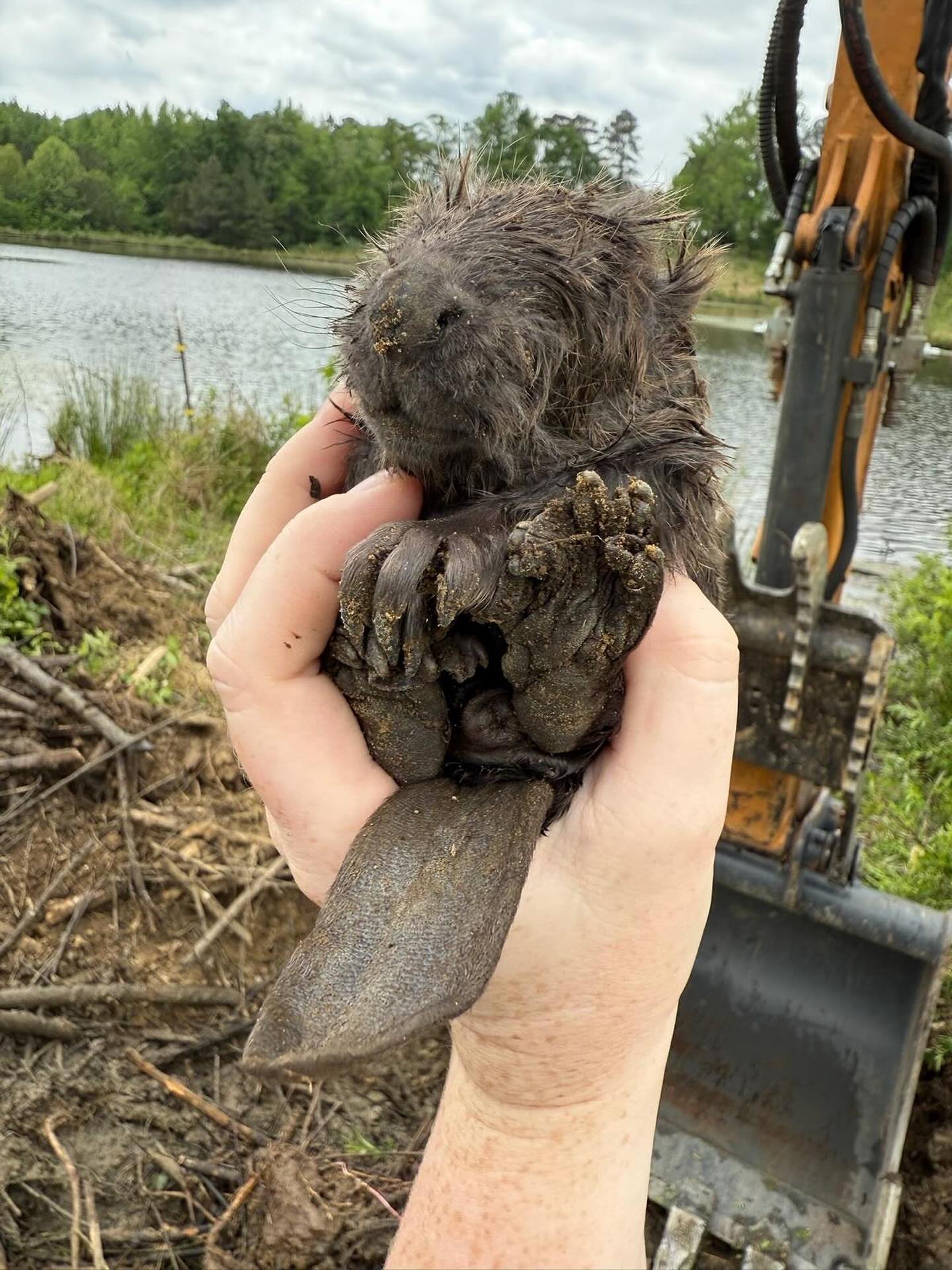
This baby beaver’s lodge was being excavated when the workers heard a tiny little cry and out popped a vulnerable newborn baby beaver. Just moments before, the baby’s mother had swum out of the lodge trying to get away from the destruction of the lodge. We almost never suggest baby beaver reuniting because baby beavers are extremely prone to pneumonia and it’s often an emergency situation when one was found. But this was a rare case where we knew mom was right there and so we gave it a chance.

The machinery was cut off and the baby was placed in a cardboard box next to the water. After just an hour, the crew returned to check on the baby beaver and there was a clear track where the momma beaver came up the bank, smashed the cardboard box down and retrieved the baby. The work was stopped and the remaining lodge was left alone.
Moral of the story: Wild animal moms are incredible. They love their babies fiercely and, when given the chance, will do whatever it takes to get them back. While reunions aren’t always possible, they should always be a priority when they are. We can care for orphaned animals, but we’ll never be a true replacement for their natural mothers. Their love and instincts are real—and powerful. ❤️


Great report from the North Coast.

Beaver-based restoration

Beaver-based restoration has been gaining popularity as a strategy for responding to growing wildfire risk in an ecologically-informed way. Raincoast connected with Jennifer Rogers from the British Columbia Wildlife Federation to learn more about their 10,000 Wetlands Project and how it might inform better fire response throughout British Columbia. This article outlines how beaver-based restoration is an effective, ecologically-informed tool in the arsenal of approaches to reduce wildfire risk.

A birds-eye view of a beaver dam within a green landscape.

Finally a solution we can get behind!

Though this is normal and instinctual beaver behaviour (behaviour that is increasingly understood by the scientific community to be essential to ecological functionality), many people feel justified in removing “nuisance beavers” from the landscape either by relocation or lethal trapping. However, the chance of another beaver colony (aka beaver family) moving into the area within the next few years is fairly high. As such, there is a much higher benefit to learn to live with and work alongside beavers, rather than fighting against them. After all, humans and beavers have more in common than most people might initially realize.

Mature beavers are monogamous and have an average of two to four offspring per year, called kits. Beavers live in family units (i.e., colonies) consisting of the breeding pair and their offspring from both the current and previous year. Between the ages of 20-24 months, young beavers leave to establish their own territories. A beaver family unit tends to be territorial, occupying areas of anywhere between 0.5 to 20km², with their territorial range depending on food availability and the density of the surrounding beaver population. Perhaps more than any similarity, the trait that may be most definitive of both beaver and human behaviour is the shared ability to reshape habitats to better suit their needs.

You would think we would understand eachother better since we have so much in common.

Beavers live in rivers, lakes, and wetlands, and in more modern times, ditches and stormwater ponds. They prefer slow-moving water, and the modulation of faster-moving streams is often the impetus for dam construction. Beavers also build dams to create better conditions for siting lodges, which are used for shelter, protection from predators, overwintering, rearing offspring, and food storage. 

Though dams and lodges are their best-known constructions, beavers are also known to develop canal systems to:

    • more easily transport food and building materials throughout their territories, and 
    • expand food availability by creating better growing conditions for the herbaceous, aquatic, and woody plants they depend on for their food supply and other needs.

Taken together, beaver-built infrastructure is designed to slow the flow of water, hold it on the landscape, and foster the growth of the types of plants that beavers depend on for survival. Some of these species include alder and cottonwoods (Alnus spp.), aspen and other poplars (Populus spp.), birches (Betula spp.), maples (Acer spp.), willows (Salix spp.), dogwoods (Cornys spp.), cattails (Typha spp.), water lilies (Nymphaea spp.), sedges (Salix spp.), and rushes (Juncus spp.). Many of these species are also early successional species, that is, they establish early and quickly after a disturbance. This means that beavers not only mitigate the impacts of disturbances, but can also help recover recently disturbed sites. This is explored in more detail later in this article.

Go check out the entire article here.

BEAVER FESTIVAL XVII

DONATE

Beaver Interactive: Click to view

TREE PROTECTION

BAY AREA PODCAST

Our story told around the county

LASSIE INVENTS BDA

CONTACT US

URBAN BEAVERS

LASSIE AND BEAVERS

Ten Years

The Beaver Cheat Sheet

Restoration

RANGER RICK

Ranger rick

The meeting that started it all

Past Reports

March 2026
M T W T F S S
 1
2345678
9101112131415
16171819202122
23242526272829
3031  

Story By Year

close

Share the beaver gospel!