




There is lots of good news about the watery progress beavers have made in Plumas county in the CDFW translocation summary. Nearly half the report focuses on its successes which will convince millions that beaver relocation is the secret weapon against climate change we never knew we had. Move more beavers! Move MY beavers! The adoring fans will exclaim.
I thought you might find my comments (in blue) informative. This is from the end section of the report:
In November 2025, a family group of four beavers was translocated to a site within the Tahoe National Forest in Sierra County (Figure 15). The translocated group (Table 10) was comprised of one adult female, one subadult male, and two female kits
“Nature based solutions can have self-sustaining benefit’s but they take time, expertise and care to re-ignite once disrupted. The current summary of restoration projects provides a detailed description of goals and progress in Tásmam Koyóm but is less descriptive about the other efforts.
I wanted to offer remarks on Act V of the production. This final section discusses the release of beavers in the Sierras. Rather than repeat my concern about translocating beavers from temperate to alpine zones, I offer this quote from the recent Wildlife Act in the province of British Columbia:
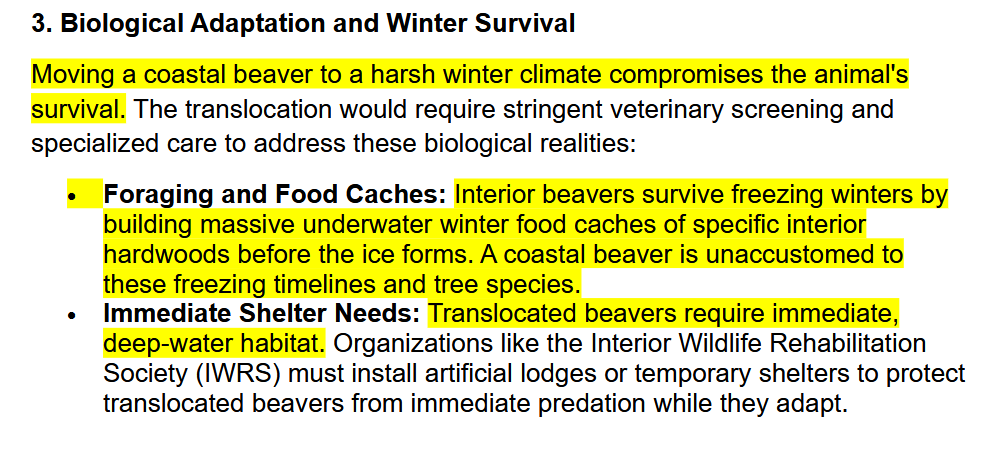 In Act V of your report it is not only assumed that displaced beavers from the delta will know effortlessly how to prepare for life in the Sierra uplands, but even more alarmingly that they will require almost no time to do so.
“Given the timing of the release and seasonal constraints with accessing the site, post-release monitoring of the beavers was limited.”
If conditions in Tahoe were too bad for staff to go back and check for beaver sign after the release, might they not also have been too bad for those beavers to build a lodge, create a food cache and find adequate safety? What can possibly explain this late release date?
In their frankly detailed paper on beaver release in 2014 by Petro et al the authors note that beavers released from August-October tended to stay nearer the release site, and no real differences in predation were reported for Spring and Summer releases by McKinstry & Anderson , There are differing thoughts about optimal release dates. But no where in any paper has it ever been ever suggested that WINTER releases are ideal. Why hang the public success of such a visible program on such an ill-advised timeline?”
A November release in the Sierras is a waste of agency resources, tax-payer dollars and frankly inhumane. Even October is considered late in the year if severe weather is likely and the beavers in question need to make food available for hungry family members all winter long. (This of course assumes that, contrary to the B.C. warnings, they would even know to do so.)
For what it’s worth I thought I would give them my version of a beaver-centric perspective. So far my inbox is missing their careful explanations and heartfelt apologies. That’s to be expected. Nobody asked for my opinion.
But they got it anyway.