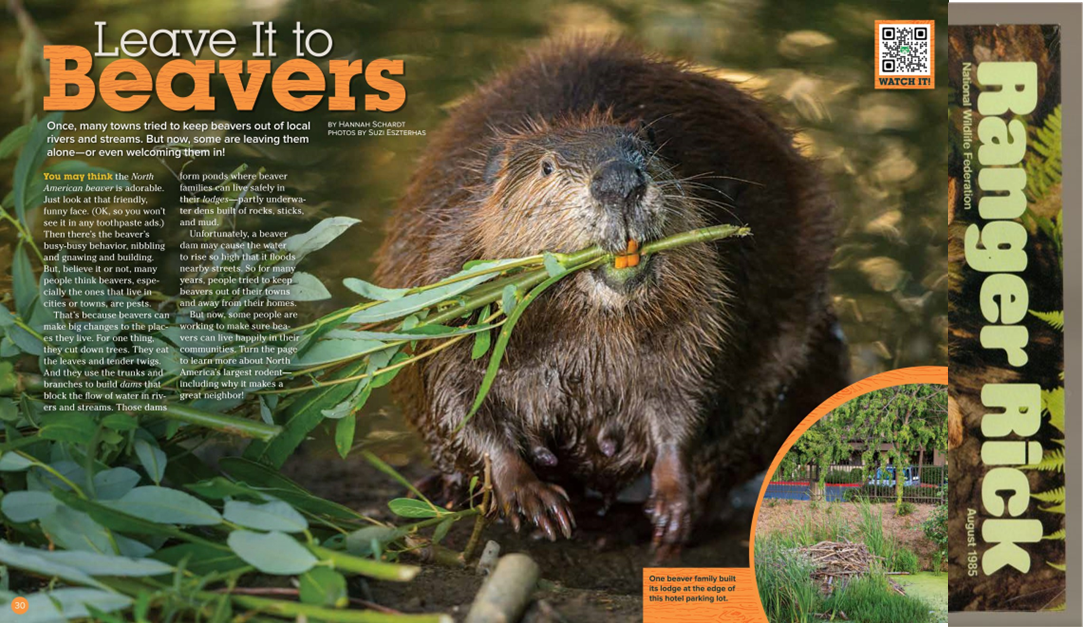





It’s my birthday today and as I have been officially out of the hospital for a fortnight and spent the last 20 years of my life saving beavers in one way or another I cannot help but believe that this article appeared just in time to celebrate my 60th. Thank you Rob!
How Mutualism Between Humans and Beavers Can Boost Our Ecosystems (and Our Happiness)
“For making our lives better, we might allow the beavers simply to live.”
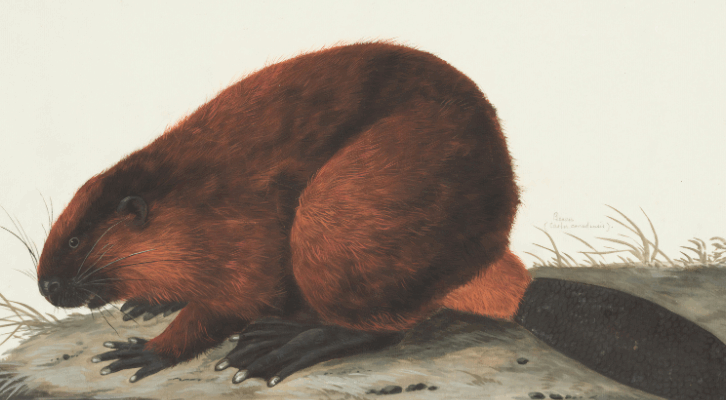
I have been walking, nearly daily, past the lodge of beavers who have begun to asynchronously collaborate with a group of engineers. In this case, the engineers did not reshape logs that had been carved by a beaver. Instead, they shaped a river and then let the beavers respond.
BE STILL MY HEART! Beaver appreciation from North Carolina? URBAN beaver appreciation from North Carolina? This is the best present a girl could ever receive!
A number of years ago, the stream was partially lifted up from beneath cement and restored. Like many stream restorations, this one attempted to make the stream more natural while also dealing with the realities of the human-built environment through which it moved. This process, led by a group of engineers, engendered a much more natural stream, and yet, as is often the case with engineered streams and rivers, one that was relatively straight, with few opportunities to meander or slow down. Modernity is ill suited to the natural peregrinations of streams and rivers.
Urban streams, even once restored, suffer a number of ailments intrinsic to their circumstances and surroundings. Urban streams accumulate the waste of cities—runoff of pesticides, herbicides, oil, and whatever else. They also become “flashy.” When it rains, all of the water that falls on the cement of the city pours, ultimately, into the stream. This causes the stream to become, quite suddenly, fast and deep. Then, after the rains, the stream becomes slower and shallower again.
Sounds exactly like Martinez.
In addition, because the runoff from rain is often heated by the cement over which it runs (the urban heat island effect), it comes into the stream hot. Such was the case with Rocky Branch. As a result, although there were more wild animals able to live on and in it than there had been before the restoration, there were still many fewer than would have been found in the creek before the city was superimposed around and atop its watershed. The animal species that persist are those with the capacity to cling tightly to rocks and tolerate extreme heat. In seventeen years of walking down this stream, I experienced relatively few surprising natural history moments. No herons. No turtles. No frogs. Few fish. Then a pair of beavers moved in.
These were not beavers in the abstract sense, not representatives of a species, but instead two specific beavers, a pair. Unlike many other beavers, these specific beavers were willing to dam a flashy urban stream. Doing so is difficult; such dams are often washed out in each new big storm. But unlike most beavers, these beavers were able to do so relatively successfully. We could ask why the beavers moved in just then, in that particular year. Perhaps it was because the trees along the restored creek had grown back enough to provide the material the beavers needed to build a dam. Perhaps not. What we do know is where the beavers in North Carolina came from, a few states north.
European colonists in America killed beavers primarily for their furs and for their scent glands, which were (and are) used in perfumes.Picture someone draped in beaver fur, smelling of beaver. The enthusiastic desire for the aesthetic trappings of beaverness led to the extinction of beavers from many parts of what had become, by then, the United States. The word “extinct” is a little deceptive, in that it doesn’t have an active form. The beavers did not “go extinct,” but instead were rather actively extinguished. After beavers were extinguished in North Carolina in 1897, they needed to be reintroduced. The beavers were shipped from Pennsylvania in 1937. NC State’s beavers were likely descendants of that successful reintroduction and rewilding of our state, of beaver begets beavers beget still more beavers. That rewilding led to this beaver act of resistance.
As an esteemed professor of Applied Ecology you should know. You are well prepared for beaver appreciation. Smart. I was much less prepared as a child psychologist. What did I know about streams or beavers?
Never mind. They taught me what I needed to know,
Over the past two years, I have had the luxury of visiting the beavers’ ponded wetland in person, which I’ve done again and again. Through these visits, I have tallied a growing list of species living in the wetland above the dam. At first, the wetland was sedate. Then mallard ducks appeared. Some Canada geese came and went. Eventually, a great blue heron materialized, stalking the water for fish. Also, sometimes, a belted kingfisher. These birds bespoke the arrival of fish. Most recently, I’ve begun to regularly spot grackles, some blackbirds, green frogs (and their tadpoles), and a turtle. The turtle is large and old and must have walked from some farther water toward this new and righteous, riotous place.
My visits to these wetlands are often social. I socialize with the species the beavers have gathered around them. Sometimes I see a human friend, such as Quentin Read, when I’m walking past. Quentin has spotted a barred owl above the dam (for which I now watch), and, in the winter, an eastern phoebe, and, in the spring, an American redstart. Recently, I spotted a white-tailed deer, which looked out at me from between some weeds before bending slowly but purposefully down to drink.
Unwittingly, the beavers and the engineers worked together to produce something much richer than what either could have done without the other. Before the work of the engineers, the creek might not have been slowed by a beaver dam. At least in parts, it was too fast, too flashy, and too circumscribed by humans. The engineers facilitated the return of the beavers. Without the beavers, the engineers had been unable to create a habitat for the many species that love and live in slower water. The beavers facilitated the return of a biologically diverse ecosystem. The beavers and the engineers collaborated asynchronously. Like many collaborations, this one has been imperfect, a halting dance. The engineers did not create a stream that was easy for beavers to live in, and yet it was a collaboration all the same.
But maybe this relationship was something more than an asynchronous collaboration.
I am in love with this article and the simple familiarity of someone visiting a beaver pond over time and seeing its dramatic changes.
When NC State professor Nils Peterson and his students studied the effects of birding on student happiness and stress, the students walked along Rocky Branch. They walked past the beaver dam and the beaver pond. They saw the birds that the beavers had recruited to the landscape. This reduced their stress and appears to have also made them happier. How much of a role did the pair of beavers play in this?
One might argue that there is a kind of mutualism between the beavers and our campus. But if that were the case, there would need to be some sort of benefit to the beavers from the humans on campus. Historically, humans have certainly not benefited beavers. Hundreds of millions of beavers have been killed in the United States by humans to make furs or perfume or because of the “nuisance” of the floods that their dams cause. In that way, humans seem among the least beneficial species to beavers. We are predators or parasites on their existence. A sword of Damocles hangs over the beavers—our sword.
When I was a kid and unclogging the culvert, my job was sometimes complemented by another form of beaver control. When there were “too many beavers,” a group of families would hire a trapper, someone like Woody, to come in and “remove” some of the beavers. It is likely, if the Rocky Branch beaver dam becomes too effective, and spills water over the paved trail along the river, that the city will trap and kill the beavers. In light of this potential, the implicit mutualism is sobering. For making our lives better, we might allow the beavers simply to live.
This is the same sort of mutualism in which we are engaged with millions of the species on which we depend for our well-being, species that benefit us and that benefit from us when we, with our Earth-shaping power, allow them to go on doing so, whether that means the species that pollinate our crops, the species that clean our drinking water, or the species that devour our pests. The great hope as we move forward is that we can imagine and create a world in which even more of the species that benefit us thrive, that we benefit ourselves by benefiting them. In the meantime, the beavers on Rocky Branch are still there, tending to their pond. I visit them nearly every day, and when I do, more often than not, I see other people there too. We stand side by side as though admiring a work of art, the city’s gray canvas slathered with the green and muddy sublime.
Excerpted from The Call of the Honeyguide: What Science Tells Us about How to Live Well with the Rest of Life by Rob Dunn. Copyright © 2025. Available from Basic Books, an imprint of Hachette Book Group, Inc.
I have already written Dr. Dunn and thanked him profusely for this present. You can believe I’m buying the book. We all need to stop every morning and smell the roses, notice the birds, and pay attention to the beavers.