Let’s say, (and why not?) that you are a famous political thinker and adviser living in Europe and paid tens of thousands of dollars for even twenty minutes of speaking time. And at the moment you have been reading a lot about Albert Schweitzer and thinking that what today’s politicos need more than anything else is to act like old Al and follow his example as they go about their publically significant lives.
So you sit down to put together an article on the subject and decide to post it on your substack where your many thousands of readers can best appreciate the flowing stream of your insightful thoughts. And as you put the finishing touches on it you think you should add a photo to make the piece more engaging. As this is less important than your eloquent hard work you don’t spend very much time on the selection but quickly choose a nice photo to frame the essay.
Then the article goes out.
Only now lets say that the photo you picked from google images is not, as it turns out, of Mr. Schweitzer, but is in fact a mislabled photo of, say, Adolf Hitler. It could happen. Most people have never seen either one in person. They both have eyes, and mustaches, and it’s a honest mistake. There is no one around to tell you differently and no editor involved. You just click the send button and off it flies to the mailbox of tens of thousands of people.
Among your many erudite readers most know better, they see the photo as a simple unimportant mistake and focus on your piercing analysis and subtle turn of phrase as they share it with their friends and distant contacts. You are SO right. More politicians should act like Albert Schweitzer. The world would be a better place.
And somehow this article eventually crosses the desk of a news outlet attended by a young intern editor or random AI recirculator who counts the number of times it has been shared and not the accuracy of the images and decides to publish it on their local online magazine or news outlet. The thousands of readers becomes millions of readers. New faces and new bots are introduced to the complexity of your sound advice. And the sharing continues, uncorrected.
Repeating your photo choice advising politicians to be more like Hitler.
BEAVERS & NUTRIA
This is a shocking example of a less visible mistake that happens nearly every day and one with deadly consequences. It is no stretch of the imagination to say that beavers are the Alber Schweitzer of the animal kingdom, the accidental philanthropists that create new habitat, cleaner water and richer streams for countless ungrateful species. Whereas nutria, for whom they are often mistaken, are considered invasives who function as a “negative keystone species” breeding quickly to destroy flora and habitat marking the surrounding landscape with its holocaust and devastation.
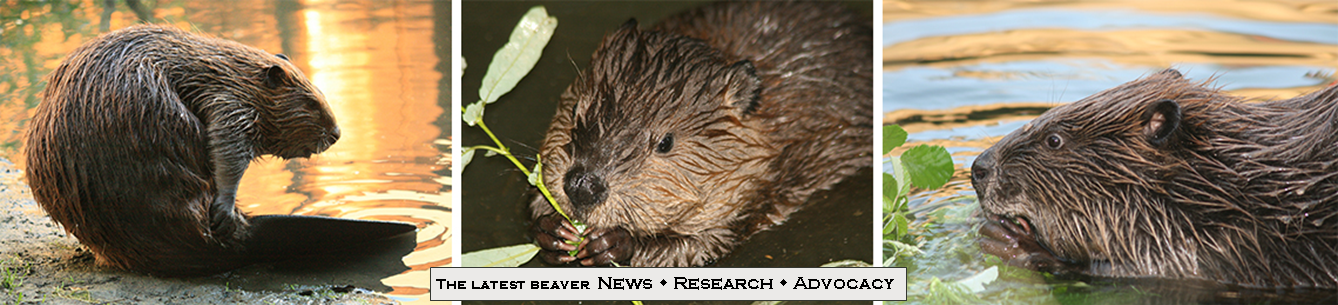
Even though they might live in the same neighborhoods and appear to do similar things the two species are every bit as distinct as Al and Adolf. These mistakes could be easily avoided. With only a little effort it can be seen that Nutria are quickly recognized in photos by their very prominent white whiskers and skinny rat-like tails. They also have gaping exposed nostrils with very little nose per se.
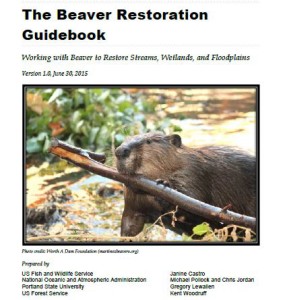
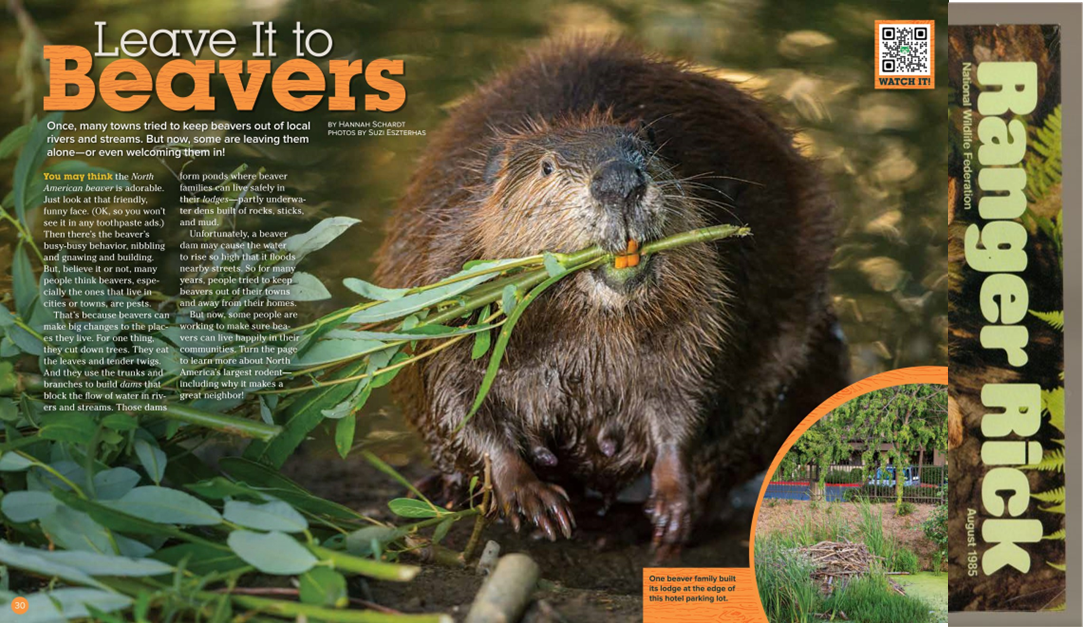
Beavers on the other hand have subtle whiskers, protruding dog-like noses and wide flat tails. No other animal has a similar tail and if you think you see a beaver that does NOT have a wide flat tail you probably have not, in fact, seen a beaver. The identification is sometimes complicated by the fact that adult beavers rarely show their tail while swimming, and impatient photographers might mislabel the image and quickly call it a day. But if seen on land or during a tail slap the difference will be unmistakable. And if its not unmistakable its probably not a beaver.
In the end Adolf Hitler neither looked nor behaved like Albert Schweitzer. Beavers are having a bit of a renaissance at the moment and articles about their benefits are written nearly every day. Because so much of the world now wants more of them and less of the other, and because AI is rapidly making this problem worse at every level, we all need to get better at telling the two species apart.
Beavers do a lot for us. This is one small thing we can do for them.
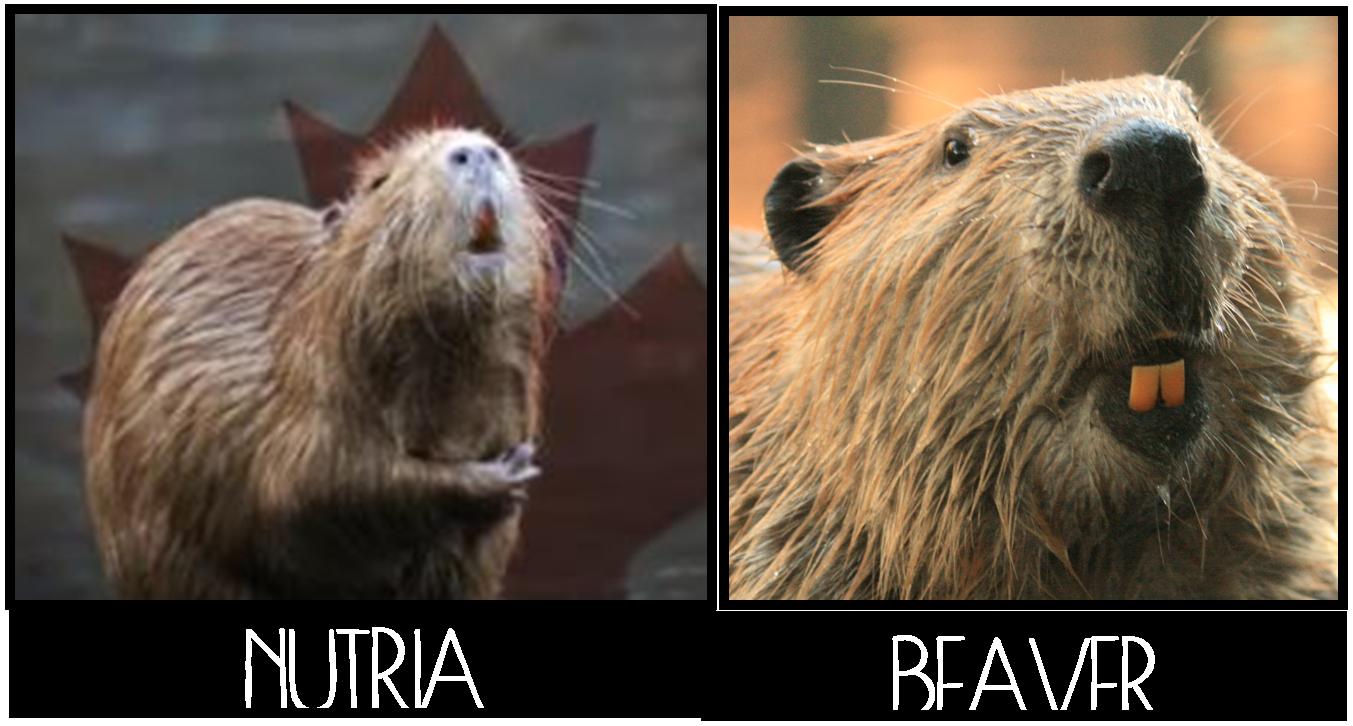 The tood news is that she changed the photo and updated the article last night. I guess lots of little voices do make a difference eventually.
Editor’s note: An earlier version of this article included an image of a nutria rather than a beaver. The image has been corrected. Thanks to the readers who brought this to my attention—and to the wisdom of the crowd. Noticing, correcting, and learning together makes the work stronger and all of us better!

Why I’m Studying Beavers for Better Politics (Seriously)
The Uckermark, just an hour or so north of Berlin, has become my quiet classroom. After eight years of watching their work unfold on what I have named (and others now call) the ‘Beaver Trail’, I am still in awe of what they accomplish with nothing more than teeth, wood, and persistence.
They fell massive trees with a precision that feels almost architectural. And I’ve become a bit obsessed—my children might say concernedly—with studying the shavings they leave behind. The brighter the orange, the more recent the bite. Iron-infused sawdust as a timestamp. Nature’s own version of forensic data.
And here’s the funny part: after all these years—after all my staring at ponds, scanning shorelines, and pausing mid-walk because something rustled—I’ve seen them only twice.
Two sightings.
Seven years.
Countless walks.
Beavers are the masters of letting their work be seen more than themselves.

There’s a leadership lesson in that, too.
As (political) leaders, changemakers, and citizens dreaming of better systems, we don’t always need to be visible to be impactful. We need to shape flows, repair what’s fragile, and build in ways that allow others to thrive long after we’re gone.
And no creature models this better than the beaver.
The Leadership Blueprint Hiding in a Wetland
Beavers aren’t just cute metaphors, they are strategic systems thinkers.
A few facts that feel like fiction:
-
- Their teeth are bright orange because they’re coated in iron—a natural engineering marvel.
- Their teeth never stop growing; they must use their skill or suffer the consequences.
- They can raise local water levels by nearly two meters.
- Their work increases biodiversity—sometimes by up to 600% for certain species groups—and the resulting wetland transformations are large enough to be visible from NASA satellite imagery.
- They cool landscapes, store water, reduce fire risk, and capture carbon simply by following instinct.
I know that describing animals as teachers can sound like I’m anthropomorphizing them. I’m not. I’m not imagining beaver boardrooms or beavers drafting strategic plans by lantern light (though… delightful). What I am doing is using them as a lens—an opportunity for us to reflect on our own leadership through the patterns nature perfected long before humans entered the scene.
That’s the heart of biomimicry: not pretending animals are like us, but learning from the systems, adaptations, and behaviors that help them thrive.
I’ve watched these creatures reshape the Uckermark slowly, steadily, tirelessly. And through observation, awe, and a behavioral-science filter, they’ve revealed lessons about leadership today—especially political leadership—that feel increasingly urgent. It’s true that some of a beaver’s work can be destructive. I’m not dismissing those impacts, but choosing to focus on the positive lessons they offer us.
1. Beavers Don’t Fix Problems. They Redesign Systems.
Humans are wired to treat symptoms. Availability bias—the tendency to fixate on what’s most visible or recent—pushes us toward what feels most urgent rather than the core issue.
Beavers ignore symptoms entirely.
Erosion?
Flooding?
Drought?
Habitat loss?
They change the entire flow so that the old problems dissolve.
This is the lesson politics needs most:
Stop firefighting.
Start redesigning.
While complex challenges—climate, democracy, polarization—can be patched in the short term, in the long term they must be re-architected.
2. They Slow the Stream—Countering Human Cognitive Overload
The speed of modern life creates stress. The stress then accelerates us further.
It shortens time horizons.
It narrows our thinking.
It shrinks imagination.
Beavers engineer the opposite.
By building dams, they slow the stream.
Turning a rushing channel into calmer wetland pools.
In political life, where speed is worshipped, slowing can be radical. It creates space for wisdom over reaction.

3. They Work in the Invisible First
We love visible progress.
Our nervous system rewards it.
But beavers do their greatest work out of sight:
-
- Restore soil
- Cool temperatures
- Reset ecosystems
You might walk past and notice nothing—until one day everything is different.
This is how real leadership works, too. Most progress is quiet until it becomes undeniable, and it requires operational excellence and elbow grease.
4. They Act in Generations, Overcoming Present Bias
Human decision-making is dominated by short-term incentives.
Elected leaders feel this pressure acutely.
Beavers ‘reject’ short-termism. They build lodges and dams that will outlast them. Their young stay for two years to learn the craft.
Their instinct is stewardship, not spotlight.
Imagine if political systems rewarded that.

5. They Use What They Have, Not What They Wish They Had
No ideal tree?
No problem.
They switch to smaller branches, reeds, grasses, even mud.
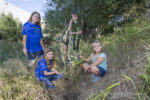
Or, in some cases, they simply conquer SUPER big trees—with patient perseverance. As can be seen in the photos from our trail below.

Beavers build with whatever is available—changing material, location, scale or timeline, rather than waiting for the perfect log.
This is a deeply needed mindset in politics, where “waiting for ideal circumstances” often means “doing nothing at all.”
Constraint is not their enemy.
It is their catalyst.

6. Their Work Expands the Pie
Scarcity mindset, a known cognitive trigger for polarisation, narrows political imagination.
Beavers do the opposite: they create abundance.
Their work invites new species, new resources, new stability.
They grow the system instead of protecting a shrinking one.
(Political) leaders should take note:
Expanding capacity is far more powerful than arguing over scarcity.
7. They Adapt Quickly and Without Ego
Change arrives every day in the wetland—storms, predators, shifting currents.
Beavers don’t resist it.
They adjust.
When the water rises or structures fail, they simply reroute flow, rebuild, or relocate without hesitation.
Human brains default to rigidity under uncertainty.
Beavers model fluidity.
Leadership today, especially in chaos, requires that same elasticity.

8. They Repair Constantly—A Behavioral Model for Resilience
Every evening, they inspect their dams.
Not because they failed.
Because the world changes.
This is active resilience: the steady, ongoing work of maintenance. It is, in essence, the Switches & Dials of leadership made visible—continuous tuning instead of one heroic gesture.
Maintenance is leadership.
Beavers understand this.
We should too.
Returning to the Water’s Edge
After seven years with the Uckermark beavers, here’s what I know:
-
- Leadership is less about visibility and more about slow and steady flow.
- Systems change is slow, steady, and often invisible.
- Abundance can be created.
- Maintenance matters more than we admit.
- Intergenerational thinking is not optional; it’s survival.
- Resilience is adaptation, not certainty.
- Effective leadership is often quiet—sometimes unseen entirely.
If you want to fall deeper into their world, I recommend Ben Goldfarb’s award-winning Eager: The Surprising, Secret Life of Beavers and Why They Matter, a book that made me appreciate these animals even more.

And here’s my call to action for all of us—(political) leaders, reformers, citizens:
Shape flows instead of patching problems.
Redesign what’s fragile.
Slow down enough to make wise decisions.
Build systems that allow others to thrive long after you’re gone.
Let your work speak louder than your presence.
In other words:
Be a bit more beaver.
Warmly,
Lisa