
Because the beaver isn't just an animal; it's an ecosystem!

Month: September 2025


It’s my birthday today and as I have been officially out of the hospital for a fortnight and spent the last 20 years of my life saving beavers in one way or another I cannot help but believe that this article appeared just in time to celebrate my 60th. Thank you Rob!

How Mutualism Between Humans and Beavers Can Boost Our Ecosystems (and Our Happiness)
“For making our lives better, we might allow the beavers simply to live.”

I have been walking, nearly daily, past the lodge of beavers who have begun to asynchronously collaborate with a group of engineers. In this case, the engineers did not reshape logs that had been carved by a beaver. Instead, they shaped a river and then let the beavers respond.

BE STILL MY HEART! Beaver appreciation from North Carolina? URBAN beaver appreciation from North Carolina? This is the best present a girl could ever receive!

A number of years ago, the stream was partially lifted up from beneath cement and restored. Like many stream restorations, this one attempted to make the stream more natural while also dealing with the realities of the human-built environment through which it moved. This process, led by a group of engineers, engendered a much more natural stream, and yet, as is often the case with engineered streams and rivers, one that was relatively straight, with few opportunities to meander or slow down. Modernity is ill suited to the natural peregrinations of streams and rivers.
Urban streams, even once restored, suffer a number of ailments intrinsic to their circumstances and surroundings. Urban streams accumulate the waste of cities—runoff of pesticides, herbicides, oil, and whatever else. They also become “flashy.” When it rains, all of the water that falls on the cement of the city pours, ultimately, into the stream. This causes the stream to become, quite suddenly, fast and deep. Then, after the rains, the stream becomes slower and shallower again.

Sounds exactly like Martinez.

In addition, because the runoff from rain is often heated by the cement over which it runs (the urban heat island effect), it comes into the stream hot. Such was the case with Rocky Branch. As a result, although there were more wild animals able to live on and in it than there had been before the restoration, there were still many fewer than would have been found in the creek before the city was superimposed around and atop its watershed. The animal species that persist are those with the capacity to cling tightly to rocks and tolerate extreme heat. In seventeen years of walking down this stream, I experienced relatively few surprising natural history moments. No herons. No turtles. No frogs. Few fish. Then a pair of beavers moved in.

These were not beavers in the abstract sense, not representatives of a species, but instead two specific beavers, a pair. Unlike many other beavers, these specific beavers were willing to dam a flashy urban stream. Doing so is difficult; such dams are often washed out in each new big storm. But unlike most beavers, these beavers were able to do so relatively successfully. We could ask why the beavers moved in just then, in that particular year. Perhaps it was because the trees along the restored creek had grown back enough to provide the material the beavers needed to build a dam. Perhaps not. What we do know is where the beavers in North Carolina came from, a few states north.

European colonists in America killed beavers primarily for their furs and for their scent glands, which were (and are) used in perfumes.Picture someone draped in beaver fur, smelling of beaver. The enthusiastic desire for the aesthetic trappings of beaverness led to the extinction of beavers from many parts of what had become, by then, the United States. The word “extinct” is a little deceptive, in that it doesn’t have an active form. The beavers did not “go extinct,” but instead were rather actively extinguished. After beavers were extinguished in North Carolina in 1897, they needed to be reintroduced. The beavers were shipped from Pennsylvania in 1937. NC State’s beavers were likely descendants of that successful reintroduction and rewilding of our state, of beaver begets beavers beget still more beavers. That rewilding led to this beaver act of resistance.

As an esteemed professor of Applied Ecology you should know. You are well prepared for beaver appreciation. Smart. I was much less prepared as a child psychologist. What did I know about streams or beavers?

Never mind. They taught me what I needed to know,

Over the past two years, I have had the luxury of visiting the beavers’ ponded wetland in person, which I’ve done again and again. Through these visits, I have tallied a growing list of species living in the wetland above the dam. At first, the wetland was sedate. Then mallard ducks appeared. Some Canada geese came and went. Eventually, a great blue heron materialized, stalking the water for fish. Also, sometimes, a belted kingfisher. These birds bespoke the arrival of fish. Most recently, I’ve begun to regularly spot grackles, some blackbirds, green frogs (and their tadpoles), and a turtle. The turtle is large and old and must have walked from some farther water toward this new and righteous, riotous place.

My visits to these wetlands are often social. I socialize with the species the beavers have gathered around them. Sometimes I see a human friend, such as Quentin Read, when I’m walking past. Quentin has spotted a barred owl above the dam (for which I now watch), and, in the winter, an eastern phoebe, and, in the spring, an American redstart. Recently, I spotted a white-tailed deer, which looked out at me from between some weeds before bending slowly but purposefully down to drink.

Unwittingly, the beavers and the engineers worked together to produce something much richer than what either could have done without the other. Before the work of the engineers, the creek might not have been slowed by a beaver dam. At least in parts, it was too fast, too flashy, and too circumscribed by humans. The engineers facilitated the return of the beavers. Without the beavers, the engineers had been unable to create a habitat for the many species that love and live in slower water. The beavers facilitated the return of a biologically diverse ecosystem. The beavers and the engineers collaborated asynchronously. Like many collaborations, this one has been imperfect, a halting dance. The engineers did not create a stream that was easy for beavers to live in, and yet it was a collaboration all the same.

But maybe this relationship was something more than an asynchronous collaboration.

I am in love with this article and the simple familiarity of someone visiting a beaver pond over time and seeing its dramatic changes.

When NC State professor Nils Peterson and his students studied the effects of birding on student happiness and stress, the students walked along Rocky Branch. They walked past the beaver dam and the beaver pond. They saw the birds that the beavers had recruited to the landscape. This reduced their stress and appears to have also made them happier. How much of a role did the pair of beavers play in this?

One might argue that there is a kind of mutualism between the beavers and our campus. But if that were the case, there would need to be some sort of benefit to the beavers from the humans on campus. Historically, humans have certainly not benefited beavers. Hundreds of millions of beavers have been killed in the United States by humans to make furs or perfume or because of the “nuisance” of the floods that their dams cause. In that way, humans seem among the least beneficial species to beavers. We are predators or parasites on their existence. A sword of Damocles hangs over the beavers—our sword.

When I was a kid and unclogging the culvert, my job was sometimes complemented by another form of beaver control. When there were “too many beavers,” a group of families would hire a trapper, someone like Woody, to come in and “remove” some of the beavers. It is likely, if the Rocky Branch beaver dam becomes too effective, and spills water over the paved trail along the river, that the city will trap and kill the beavers. In light of this potential, the implicit mutualism is sobering. For making our lives better, we might allow the beavers simply to live.

This is the same sort of mutualism in which we are engaged with millions of the species on which we depend for our well-being, species that benefit us and that benefit from us when we, with our Earth-shaping power, allow them to go on doing so, whether that means the species that pollinate our crops, the species that clean our drinking water, or the species that devour our pests. The great hope as we move forward is that we can imagine and create a world in which even more of the species that benefit us thrive, that we benefit ourselves by benefiting them. In the meantime, the beavers on Rocky Branch are still there, tending to their pond. I visit them nearly every day, and when I do, more often than not, I see other people there too. We stand side by side as though admiring a work of art, the city’s gray canvas slathered with the green and muddy sublime.

Excerpted from The Call of the Honeyguide: What Science Tells Us about How to Live Well with the Rest of Life by Rob Dunn. Copyright © 2025. Available from Basic Books, an imprint of Hachette Book Group, Inc.

I have already written Dr. Dunn and thanked him profusely for this present. You can believe I’m buying the book. We all need to stop every morning and smell the roses, notice the birds, and pay attention to the beavers.
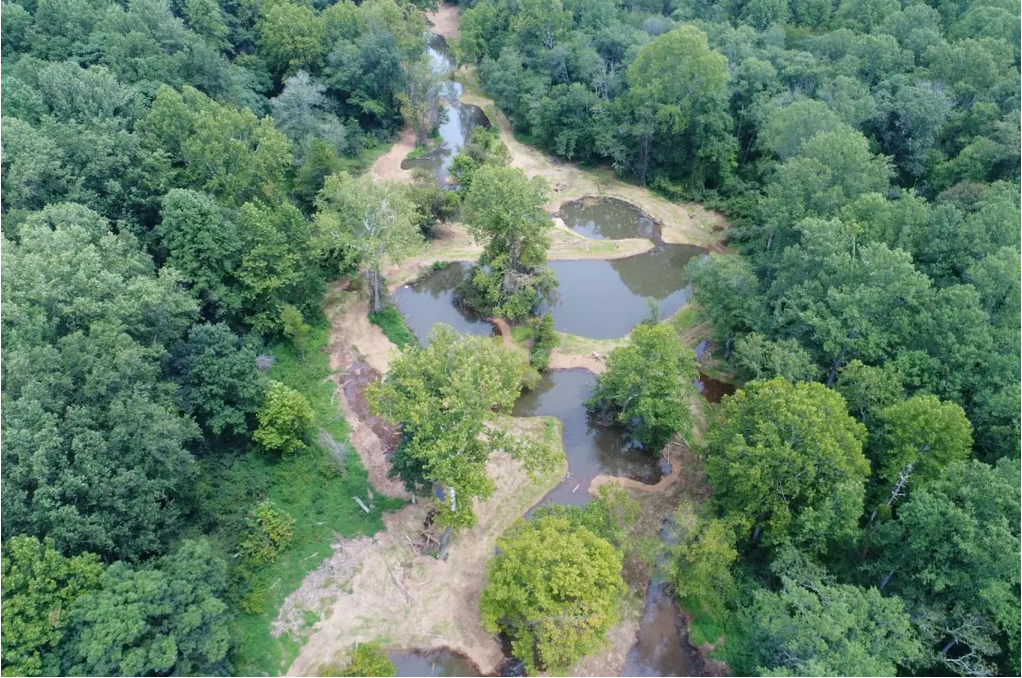
I love this news report with a fiery passion. Not only did they repair their park with BDAs because of all the good things caused by beaver dams. they also can’t wait for beaver dams to move in and take over and even planted things to attract them!

New Virginia park inspired by beavers

At nearly 1,200 acres, Biscuit Run is the largest park in Albemarle County, featuring more than eight miles of trails and one very unusual stream. It cut deep into the land, eroding its banks and flooding areas downstream, but over the last few years the county has been building small dams — using soil, tree limbs and other natural materials to create 35 ponds.

“We’re building in the stream dams like a beaver would do, so we’re blocking the flow, creating pools behind that dam, and we’re doing a series of these,” says Greg Harper, Chief of Environmental Services on the project.

He explains that the dams will help clean a polluted stream and force storm water to spread out, rather than flooding nearby neighborhoods.

“These beaver dams are going to trapping sediment and pollutants like nitrogen and phosphorous, and it will also allow during storm events the water to come out of the stream and flood the nearby flood plain.”

The project cost about $2 million, half provided by the state, and Harper hopes to get some free help with these new structures.

“We knew that beavers exist in the park, so we’re hoping they’re going to discover the work that we’ve done and kind of maintain what we’ve started.”

To entice those critters, the county is offering free lunch.

“We are planting some vegetation that would be attractive to the beavers, that they could munch on.”

The site should also appeal to those who enjoy fishing, but Project Manager Audrey Storm does not advise swimming.

“I think that it will be tempting, but it is definitely not recommended that anybody swim. The depth of some of these pools is up to ten feet, and so they look very inviting, but they are definitely a hazard, especially if you don’t have swimming, life-saving abilities and then recognizing that there are a lot of trees and limbs and things that are shoved in, in order to help prevent that — there could be some additional hazards associated with it.”

In addition to its scenic and recreational value, the newly improved stream could prove a plus in the event of a forest fire on this heavily wooded site. Kip Moomaw is principal engineer for ecosystem services.

“There’s a lot of research in how beaver dams and this type of system can help provide a fire break. It can be a refuge for wildlife during those events.”

Eight more dams will be built this fall. Experts hope they will increase the diversity of wildlife and plants in the Biscuit Run Valley.

Nicely done Virginia. Nicely done.


New Mexico had the first beaver summit, and inspired all of us to follow along behind. Now they are plowing ahead and we can watch with delight:

For the love of beavers

WildEarth Guardians believes not only in protecting the Wild–whether that means roaming wolves, tiny mussels, or beautiful landscapes–but in healing it as well. For years, our restoration program planted willow and cottonwood to help bring waterways back to their complicated and vibrant best. Now, we are partnering with the world’s second most impactful engineer, the beaver, to improve ecological function, fire and flood resiliency, and biodiversity to degraded watersheds.

If somehow you haven’t heard, beavers can be our best friend in terms of fighting the symptoms (and even the root causes) of the climate crisis.

This year, the New Mexico legislature took note of their importance and specifically directed funding toward beaver conservation. And a bi-partisan group of legislators supported a memorial to create a statewide beaver management plan. Guardians advocated tirelessly for both of those measures. But we’re not done – we’re also putting skin in the game (or our boots in the mud) to help get more beavers in beneficial places, and importantly assist New Mexicans who live with beavers, which can be tricky.

Earlier this month, we co-hosted a two-day beaver coexistence training with our partners, Beaver Institute and Rio Grande Return. Attendees came from across northern New Mexico, some representing state and federal agencies, tribes, and NGOs, to learn how to coexist with our wide-tailed friends. Led by Dr. Aaron Hall, we learned important beaver coexistence technologies including tree fencing, culvert protection, and critically, flow devices. These relatively simple but nuanced installations can all play a role in helping beavers bring benefits to a landscape, without causing damage to infrastructure like roads and acequias.

As if that wasn’t enough, the day after our training ended, we again partnered with Beaver Institute and our friends INDIGENOUS LED to host Animal Medicine: A Gathering for Relatives. We welcomed nearly 100 attendees to join us for an evening of meaningful movement, short films, and a panel discussion, featuring people who partner with beavers, bison, and wolves to heal Western landscapes.

If hard scrabble New Mexico can do it, California surely can. Right?

This was an expansive event that probed our relationships with species that have been nearly wiped out and are now slowly making a comeback throughout their native range, despite hostility and misunderstandings. How we share a future with these ecological and cultural icons is going to inform how, and maybe if, we will continue to thrive in the West. Without the beings that enliven these landscapes and literally make them work–the beaver by engineering waterways, the wolf by balancing food webs, and the bison by wlowing and carefully grazing–the West just isn’t right.

Guardians and our allies will continue to not only defend these species and push for their restoration, but we will also work with them, learn from them, and deepen our relationships with them in order to fulfill our mission.

It’s a little bit challenging to life with wolves and beavers. And a little bit challenging to live in a democracy. What we know is that its worth it.

Way worth it.


California specific focus on beavers. I’m told that this will be a two part article and Worth A Dam will actually appear in the second one. In this article oddly Heidi doesn’t exist.

Beavers restored to tribal lands in California benefit ecosystems

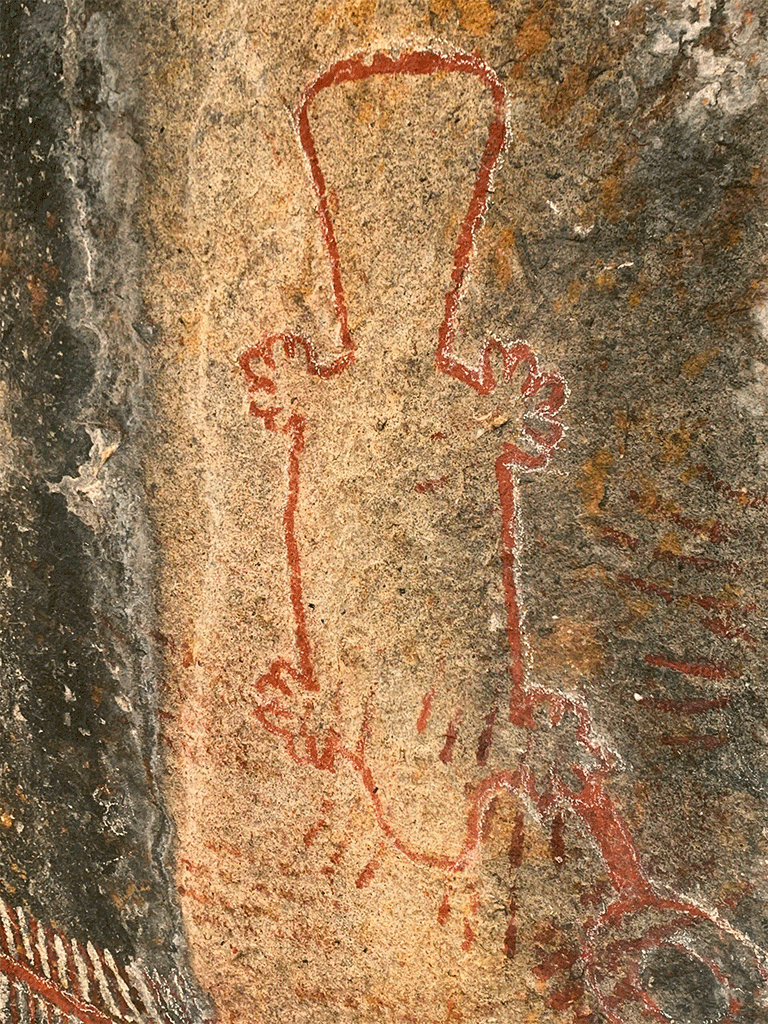
CHESTER, Calif. — The pictograph, an ochre-red outline with four paws and an unmistakable paddle of a tail, has been on the reservation “my whole life,” said Kenneth McDarment, a member of the Tule River Tribe. It’s just one of many paintings — of people, geometric designs and other wildlife — from 500 to 1,000 years ago adorning the walls of a site called Painted Rock in the southern California foothills of the Sierra Nevada mountains.


But today, it stands out to McDarment, who formerly served on the Tule River Tribal Council.

“Sometimes you need to just look at things more often,” he told Mongabay.

About a decade ago, a succession of drought years parched the land, and leaders were searching for ways to shore up the reservation’s water.

Was there ancient wisdom in that artist’s depiction of the beaver, an animal long absent from these lands? If the tribe could return them to the reservation, McDarment thought, they might have a solution to their water woes.

The potential benefits of beavers are manifold, from fire prevention and resilience to improved water quality and fishing. As these “ecosystem engineers” construct their lodges and dams, they alter the courses of brooks, streams and creeks, forcing the water to spread out beyond the banks and remain in parts of the landscape for longer.

So, the Tule River Tribe decided to find a way to bring them back.

Bringing back beaver is a pretty lofty goal. Something lots of us have been fantasizing about for a long time.

A muddied history

The relationship between beavers and people has been particularly fraught over the past several hundred years in California: A continent-wide assault on beavers (Castor canadensis) for the fur trade killed tens to hundreds of millions across North America, and they disappeared from many parts of the state. Since then, the few survivors and their descendants in California have often clashed with humans when beavers cause flooding and other issues.

Recently, though, things have started to turn: In 2023, the state began a beaver restoration program through the California Department of Fish and Wildlife (CDFW). Most notably, the program partnered with the Tule River Tribe, as well as the Mountain Maidu people in northern California, to move beavers to tribal lands from areas where they were causing problems for humans, primarily in the watersheds of the Sacramento and San Joaquin rivers.

At the northern end of the Sierra Nevada, reintroduced beavers now live in a meadow called that the Mountain Maidu call Tásmam Koyóm, which means “tall grass.” The beavers’ homecoming has reinvigorated the wetland habitat, drawing in wildlife like willow flycatchers (Empidonax traillii), sandhill cranes (Grus canadensis) and river otters (Lontra canadensis). These moist grasslands can also put the brakes on the destructive fires that beleaguer the forests of dry western states like California. And the dams store water and trap silt, improving water quality downstream for fish and humans alike.

On the Tule River reservation, several releases since 2024 haven’t yet led to the beavers’ permanent return, with the first groups having likely fallen victim to predators. McDarment and the tribe remain undaunted, however: “We’re happy to be moving along as we are, and hopefully we’ll keep receiving beaver to add to our watershed.”

But the translocations of beavers, like the spires of the Sierra Nevada crest that loom to the east of the Tule River Reservation, are just the most visible part of a massive batholith. The foundations of a shift toward living in harmony with beavers lie in decades of education, research and advocacy.

“The concept of beaver restoration and the importance of beavers in California didn’t start with the creation of the program,” said Valerie Cook, CDFW’s Beaver Restoration Program manager.

The broader aim of those involved has been to reimagine humanity’s relationship with a species that is a close cousin of ours — if not genetically, then at least in the ways beavers similarly bend the environment to their needs.

I like “muddied history” It’s way better than a “Gnawing problem”.

A ‘century of amnesia’

The Occidental Arts and Ecology Center (OAEC) in California’s Sonoma County has been at the forefront of the movement to restore, benefit from — and coexist with — beavers for more than 20 years. But from early on, the center’s Brock Dolman said he noticed Californians’ “cerebral imperviousness” to the benefits of more peaceable relations with beavers.

Fond of ecological metaphor, Dolman said, “To get to the ecosystem restoration, we have to restore the egosystem, which starts in the headwaters, which is the water in our own heads.”

In contrast, other states were pouring resources into beaver restoration and beginning to reap the benefits, said Kate Lundquist, co-director, with Dolman, of OAEC’s WATER Institute.

“California had this massive beaver blind spot, as opposed to what was happening in Oregon and Washington and Utah,” Lundquist said. “Everyone else in the arid West was really starting to get their beaver act together, and California was surprisingly behind.”

Among the currents flowing against beaver restoration was the long-held — and it turns out, erroneous — assertion that beavers had only ever been native to a small sliver of the state.

Hunters wiped out most of California’s beavers from their former range by the mid-1800s, and that led to “a century of amnesia” about beavers, Dolman said. By the time zoologist Joseph Grinnell was studying them in the early 20th century, perhaps a thousand remained in California.

Grinnell’s surveys turned up most of the state’s beavers in the low-lying valleys of the Sacramento and San Joaquin rivers. That led him to report in Fur-bearing Mammals of California, a seminal guidebook, that they had probably never lived in the state’s mountains.

But beavers had proven their adaptability elsewhere, colonizing the high elevations of other North American mountain ranges and just about everywhere else outside of the continent’s deserts. By the late 1980s, physician-scientist Richard Lanman and others had started gathering clues that beavers had been far more widespread in California.

The mostly dry creek bed that ran through Lanman’s property in Silicon Valley initially sparked his interest. The home’s previous owner had told Lanman he had fished for steelhead trout in the stream decades before. That didn’t seem possible — unless, Lanman thought, once-present beavers in the region had played a role in damming water upstream, providing for more consistent flow.

But according to Grinnell’s maps, this part of coastal California had also never been home to beavers.

Now now now, You might be asking your self if folks have been advocating for beavers for 20 years why didn’t they help beavers in Martinez in 2007? Well that’s a pickle, considering that we were national news. But I did hear from Rick around 2010. And he did tell me about the stream behind his house and thinking beavers were native.

As a physician, Lanman said, he was trained to develop multiple diagnoses for a patient’s condition. That skill may have helped him think through a variety of unique explanations, for example, why the creek had become so anemic by the time he arrived. He also sees his naivety as an outsider in ecology as an advantage.

“I’m not an expert, right? It’s a new discipline for me,” Lanman told Mongabay. “Maybe that’s what makes it easier for me to question the status quo.”

Years later, Lanman was still nurturing an interest in the beaver’s “historical ecology” when he linked up with Charles Darwin James, an archeologist. In 1988, James had found what appeared to be two beaver dams in a mountain meadow near Red Clover Creek in the Sierra Nevada, not far from the Mountain Maidu’s Tásmam Koyóm. The wood in the structures had gnaw marks and had been woven together — telltale signs of beavers.

Carbon dating one of the dams punctuated the discovery: The oldest section was from around 580, and another dated to 1730; the most recent came from around 1850. The results were clear evidence of beavers’ long persistence here, high in the mountains at 1,637 meters (5,371 feet) above sea level, refuting Grinnell’s contention that they’d been confined only to the lowlands.

The beaver’s presence on the creek also vanished from the record right when Lanman expected it to, at the end of what he calls the “California fur rush” and the beginning of the California Gold Rush in the mid-19th century. The onslaught, it turns out, served to wipe out not only the beaver itself but also the memory of its presence throughout much of the state, at least for Western science.

In 2012, James and Lanman published their findings in the journal California Fish and Game (now called California Fish and Wildlife Journal). Lanman turned out more studies, collaborating with Dolman and Lundquist, that tapped into other veins of evidence for beavers’ presence in the Sierra, and beyond, including coastal California.

Lanman had pored over settlers’ journals and observations for mentions of beavers, and he dug into California’s Native American languages. “All the tribes had words for beaver, from San Diego to Mount Shasta,” he said, an indication that beavers existed within the tribes’ territories, or at least nearby. And the research drew on evidence like the Painted Rock pictograph on the Tule River Reservation as a demonstration of its presence in both the landscape and the cultures of the peoples with whom they shared the landscape.

“It wouldn’t have been there if it wasn’t a significant piece of history,” McDarment said.

So Worth A Dam did the flyway festival back around that time and Cheryl talked to forest service Barry Hill who said he knew about an archeologist who was studying a beaver dam in the 90’s. So Heidi called Chuck Darwin James and we had an amazing chat and then she talked to Rick who was interested in a California Fur Rush study and that’s how that connection came to be.

Go Figure.

Building momentum

For much of the 20th century, humans’ own hydrological engineering — for canals, dams and irrigation for agriculture — througout California engendered a “lethal relationship” between beavers and people, Dolman said. From about 1920 to 1950, there had been a program to relocate “problem” beavers to mountain areas. But after World War II, the push for development largely won out, supported by wildlife authorities’ belief in Grinnell’s historically narrow range for beavers in the state.

“It was really just, ‘Get them out of our way. They’re an impediment to progress,’” Dolman said. The approach was, “‘We don’t need these pesky nuisance [animals]. And if they’re not native, all the better, so we can just kill them,’” he added.

By the early 2000s, the OAEC — which Dolman said focuses on “demonstrating solutions where there’s dirt under the nails” — had involved itself in efforts to help California’s cratering coho salmon (Oncorhynchus kisutch) population in the Russian River. The center soon seized on the role that beavers could play in the “process-based restoration,” not just of salmon populations, but of entire watersheds.

Lundquist called that focus a “no-brainer.” They ended up asking themselves, “Why aren’t more people actually doing anything active to restore beaver with that intention?

“That gave us our marching orders,” she added.

Early on in the center’s ‘Bring Back the Beaver’ campaign, they noticed how widespread “misperceptions” helped perpetuate an adversarial human-beaver relationship, Lundquist said — that beavers hurt fish populations, for example, or that they’re bad for farmers.

To this day, the center continues to focus on education to dispel these myths. They’ve also developed tools to foster coexistence for landowners who might need help installing a pond leveler to deal with flooding from beaver dams, or pointers on wrapping trees with protective wire so beavers don’t chomp on them until they fall.

It only takes a spark to get a fire going they say, but with beavers it takes a WHOLE BUNCH OF FLAMES to move the needle.

‘Welcoming home’

Correcting the historical record to reflect the beaver’s widespread presence and starting to shift the state’s beaver mindset buttressed a nascent foundation for coexistence. Then, in the mid-2010s, the Tule River Tribe and the Maidu Summit Consortium each approached OAEC. They both wanted to bring beavers back to their tribal lands, but hurdles stood in their way.

“At that time, there was no way to move beaver in California that was legal,” McDarment said.

So the coalition soon engaged in what Dolman calls “the democratic arts of policy change,” working with “the only beaver lobbyist in California” to spark a series of successes for beaver restoration.

In 2019, a petition to the California Fish and Game Commission set out to change the way the state’s wildlife agency issues “depredation” permits for beavers causing problems. Ultimately, in 2023, CDFW policy was updated to include recommendations that landowners try non-lethal “coexistence” measures when possible, before being allowed to kill them and to prevent future conflict with beavers. The department’s beaver web page now also acknowledges beavers’ “conservation value.”

The year prior, in 2022, California’s Governor Gavin Newsom included a beaver restoration program in his budget. Then, in 2024, Assembly Bill 2196 made support for the program permanent.

Then, on Oct. 18, 2023, California relocated its first beavers in more than seven decades, releasing seven on Indigenous Mountain Maidu lands in northern California. Shannon Salem Williams, who is Mountain Maidu and a program manager for the nonprofit Maidu Summit Consortium, said seeing the beavers slip into the water in the Tásmam Koyóm meadow was “a full circle moment.” The Mountain Maidu consider beaver — hi-chi-hi-nem — to be family.

“It was like a big welcoming home,” Williams said. The beavers brought with them the promise of healing for the meadow, a spiritual place for the tribe, she added. Today, the colony has built a 100-m (328-ft) dam at the edge of a pond and blocked off a nearby rivulet to push water back into their pond. An April 2025 report by CDFW credits the beavers with increasing water coverage in the meadow by more than 22%. They’ve also burrowed into the bank of a creek further downstream.

The department has since released more beavers at the site — as Dolman put it, “because the success is so amazing.”

Of course they mean the success of the beavers. Not the success of the program itself. Which relocated at least a dozen beavers in to the mouths of bears.

Live and learn.

BEAVER FESTIVAL XVII

DONATE

‘HOPPERS’ COUNTDOWN


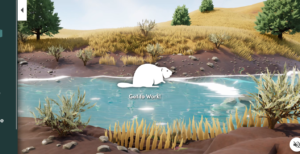
Beaver Interactive: Click to view

TREE PROTECTION

BAY AREA PODCAST

Our story told around the county

LASSIE INVENTS BDA

CONTACT US

URBAN BEAVERS

LASSIE AND BEAVERS

Ten Years

The Beaver Cheat Sheet

Restoration

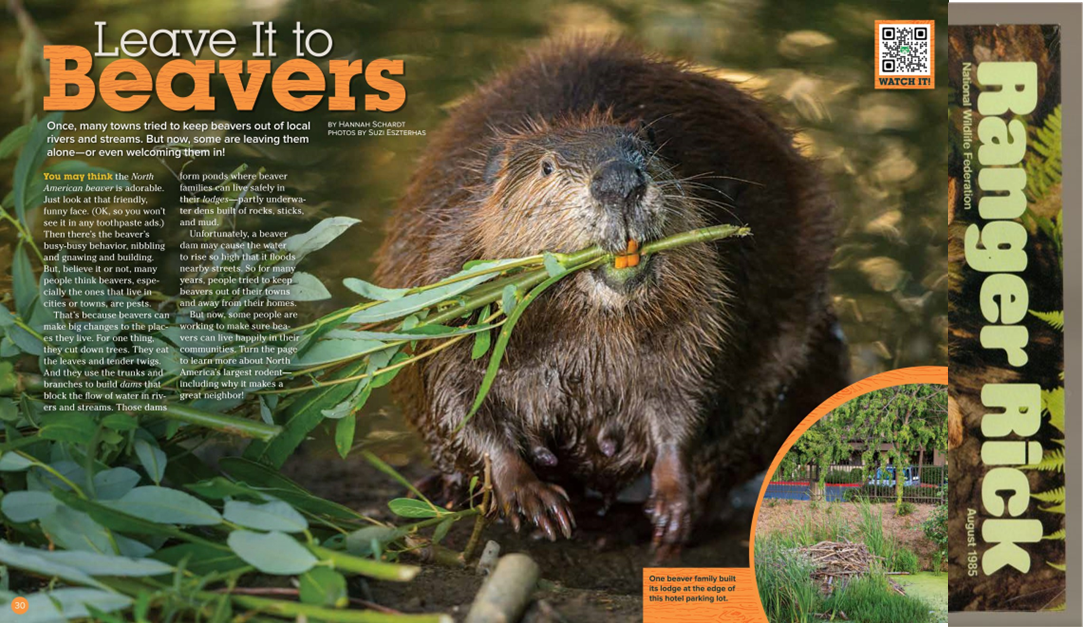
RANGER RICK

Ranger rick

The meeting that started it all

Past Reports

September 2025
M T W T F S S
1234567
891011121314
15161718192021
22232425262728
2930  

Story By Year

close

Share the beaver gospel!