
Because the beaver isn't just an animal; it's an ecosystem!

Month: June 2016


It’s summer and we’re all busy planning our vacations. Worth A Dam thought we’d visit England, courtesy of Cheryl Reynolds awesome photo which has traveled the globe via wikipedia for nearly a decade. To be honest, back when we gave Rickipedia this photo to use on his updates we had no idea it would show up in Bavaria or Wales for over a decade. But it’s nice to see its shining face time and time again.

Capture

The report published this morning by the Environmental Audit Committee exposed the Government’s knee-jerk reaction to flooding. During the last Parliament funding was cut just before floods, only to be “increased” after the floods. The funding has fluctuated year by year.

The Committee has demanded an action plan from the Government.

Beavers should be part of that plan.

Earlier this year, just one month after floods raged through towns across the UK, a study by scientists at the University of Stirling demonstrated how Scotland’s beavers have mitigated flooding.

Beavers are famous for creating dams with ponds of deep quiet water. One of the many purposes of these dams is to slow the flow of water, to stop beaver homes being washed away. Further downstream, these networks of upstream dams work like big sponges. They provide a slower, steadier flow of water into our towns and lowlands. Our current policy of dredging does the opposite – forcefully deepening and widening riverbeds to provide a faster and at times perilous flow of water into our towns and lowlands.

The water trickling out from beaver habitat is also cleaner, with sediments retained upstream. Just last week the Environmental Audit Committee declared that more action is needed to protect UK soil health. Rewilding these semi-aquatic rodents could help prevent soil erosion.

Beavers also create a variety of habitats for fish (which as herbivores they won’t eat), mitigate dry summers, create ecotourism opportunities, boost plant life and local populations of birds, amphibians, mammals, insects and other animals. They are a win-win-win-win situation.

Vote Beaver.

Of course everyone who walks by my home for the next century will know how WE voted. Mario is almost finished and I could not be happier. I especially love to think that every time the mayor is late for a meeting and decides to block our parking space he will see this staring back at him.

DSC_7086Here’s a closer look at who’ll I’ll be drinking my morning coffee with for the rest of my life.

DSC_7078


Orphaned beaver kits learn to swim at Salthaven wildlife centre

Four orphaned beaver kits are testing out their growing strength as they learn to swim, weeks after they arrived at Salthaven Wildlife Rehabilitation West as cold and weak newborns.  The young beavers arrived at Salthaven in early May after trappers found them next to their mother, which they caught in a trap near Fort Qu’Apelle.

Because that’s what trappers do: “trap some, save some” It’s like a lethal daisy petal-plucking game of he loves me he loves me not. Some day I might have to sit down with beaver rehabbers and say, you realize this  is kinda futile, don’t you? Why not spend some of your donations on education so people realize they have other options next time?

But there’s no denying the pictures are cute.

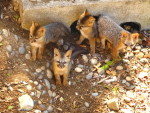
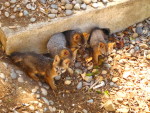
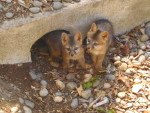
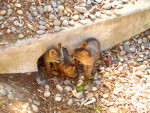
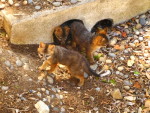
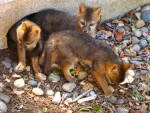
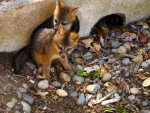
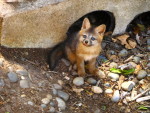
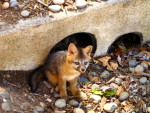
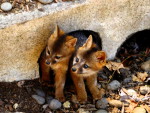
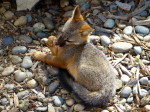
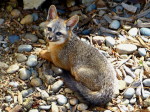
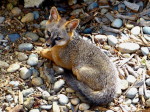
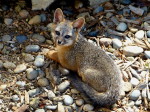
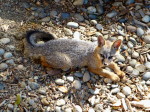
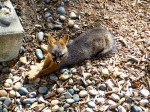
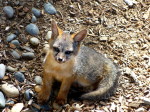
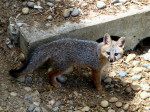
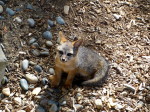
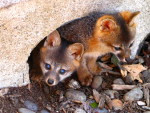
Speakibrianng of cute pictures, a few of you might remember Brian Murphy from Walnut Creek Open Space and Audubon at the beaver festival. He’s been with us since our VERY first festival and he is a great champion of wildlife. Well, he’s been watching a fox den under his porch and caught the kits hiding out in the drain pipe the other day. I know we’ll want to thank him for these photos personally at the next beaver festival!


Your final dose of cuteness will await me every day I step onto my porch for the rest of my life.  Mario will be finishing up the great blue heron and the dam today. Just in time for the festival planning meeting this weekend! Just admit it, you’re jealous.
DSC_7064


There’s a fair bit of good news for beavers this morning, first this report from Calgary;

‘He’s quite shy’: Beaver sightings on the rise in Calgary

You notice that despite the city’s goal of ‘coexistence’ they still managed to find a few folk who call beavers pests for the interview. Journalism! Then there was this lovely article from Oregon yesterday. When it was published it had the photo listed as ‘courtesy’, I wrote the managing editor that we weren’t feeling particularly ‘courteous’ and he needed to change the credit immediately. All better now enjoy.

CaptureNature’s engineers

CaptureWhile some see the beaver, officially a semiaquatic rodent, as destructive, beavers are “woefully misunderstood,” says Esther Lev, the executive director of The Wetlands Conservancy, a statewide group based in Portland.

Beavers got more than their usual share of attention in May, during the 24th annual celebration of American Wetlands Month. The beaver was a headliner this year.

The North American beaver (Castor canadensis) — Oregon’s official state animal — possesses an instinctual work ethic that is closely connected to the way it builds its habitat. Beavers create stick-and-branch structures with underwater entrances for protection from predators, and in the process expend an enormous amount of energy gnawing and gathering wood. If their lodge gets destroyed, they’ll rebuild twice as fast and twice as sturdy.

Lev, a widely respected expert in wetlands education and conservation with more than 30 years of experience, says beavers make a multitudquotee of important contributions to our ecosystem. “Beavers not only create wetlands, but also create spawning and rearing habitat for salmon and steelhead,” she says. “Their ponds help filter water and moderate fluctuations in water flow downstream.” They also provide habitat for a wide array of insects, birds and amphibians.

While research shows that beavers make ecosystems more complex, they’ve long been incorrectly blamed for flooding, Lev says.

She calls them “nature’s hydrologists.”

Streams and rivers where beaver dams are present show high clarity and low pollution levels. As beavers build their dams across waterways — with their lodge at the center of it — a pond is created. As the water flows and filters through the dam, water quality improves and nutrient-rich sediment collects in the bottom of the pond, creating a food source for bottom feeders. Eventually, the beavers move on, their dam breaks down, and the pond slowly percolates into the surrounding terrain, leaving behind a lush meadow composed of nutrient-rich soil.

Studies suggest that there are a number of species whose survival is dependent on beavers’ “engineering” their environment. Typically, when beavers fell a tree, more light gets to the forest floor, which, in turn, helps remaining trees grow and thrive. Better light also encourages a diversity of plant life. And as the remaining stump grows new shoots, that serves as food for moose and elk.

Research shows there’s a greater abundance of birds, reptiles and plant life in areas inhabited by beavers. Migratory birds prefer the safety of landing on beaver-created ponds to open bodies of water.

Fantastic article! And following nicely on the heels of the Portland talk. Lev is the woman who was grateful my talk ‘ wasn’t delivered by a biologist’. So I know she received excellent reminders of beaver value in the landscape fairly recently if she needed them. I’m so old I can remember when talking about beaver benefits raised many an eyebrow, now we get two examples on the same day! What will tomorrow bring?

But the very best part of yesterday had to be this, which almost brought me to tears when I opened the door. That beaver and I have been through a lot together.DSC_7035