



Because the beaver isn't just an animal; it's an ecosystem!


FacebookFacebook
email articleemail article

Do we think of Montana as a beaver-saving hotspot? Looking at this article I’m thinking maybe we should. Check this out:

Guest view: Recreational trapping of beavers should be banned

Wetlands are among the most critically threatened habitats that provide for high species diversity and storage of water we all depend on. Beavers create life-sustaining wetlands. Yet, Montana’s recreational trappers kill an unlimited number of beavers every year for fur and recreation.

One million animal and plant species are at imminent risk of extinction.

Anja Heister

We need leadership now. The Montana Department of Fish, Wildlife and Parks could immediately suspend recreational trapping of Montana’s wildlife because the governmental agency realizes that it is urgent to start preserving wild animals. FWP administers its trapping program strictly for recreation. In Montana alone, trappers brutally kill tens of thousands, if not hundreds of thousands of wild animals caught in leghold traps, conibears and snares, every trapping season. If these animals were allowed to survive, they would hopefully enjoy their lives, including raising a family and by doing so, fulfill important ecological functions crucial to ecosystem resilience.

Whoa! Banning recreational trapping in Montana because beavers make life-sustaining wetlands. I’m rubbing my eyes. Is this a dream? Of course that wouldn’t work here. Here in California you could ban ALL recreational trapping and fur trapping of any kind and 3000 beavers a year would still be on the hit list. We’re civilized.

California, of course, kills beavers because they’re “inconvenient” not because its fun.

In the era of climate change and accelerating extinction crisis caused by humans, the massive recreational trapping of wild animals becomes not only appallingly ludicrous but dangerous for all of us. Sir Robert Watson, IBPES chair, noted that exploitive human activity is “eroding the very foundations of our economies, livelihoods, food security, health and quality of life worldwide.”

Montana provides headwaters for the entire continent, but trapping has caused a steep decline of beavers (and other wild animals), which has dried up streams and wetlands for beavers to inhabit. However, there are still suitable places for reintroduced beavers to thrive — but only if traps are off the landscape.

Now this is a SMART letter. ‘Montana provides headwaters for the entire continent” is my very favorite sentence. Beavers protect and maintain those headwaters. Don’t stop trapping because it’s cruel, or icky (even thought it is). Stop killing the things that save your water. The things that could save US from climate change. This writer knows what she’s doing.

No environmental impact statement has ever been conducted to assess the major ecological impacts of removing tens of thousands of animals from their habitats by Montana trappers every year. Such a scientific assessment would likely show damaging shock waves to ecosystems. Indiscriminate trapping unravels a strong network of stability in ecosystems we depend on.

Wow! You are my new favorite human in Montana Anja! She’s a postdoctoral fellow at UM and the executive director of Footloose Montana. So she know a thing a two about her audience. I sent her the info about Mitch Wagner’s signature case arguing that beaver removal should require an EIR and let Mitch know about the article as well, but who knows, maybe they’re already best friends?

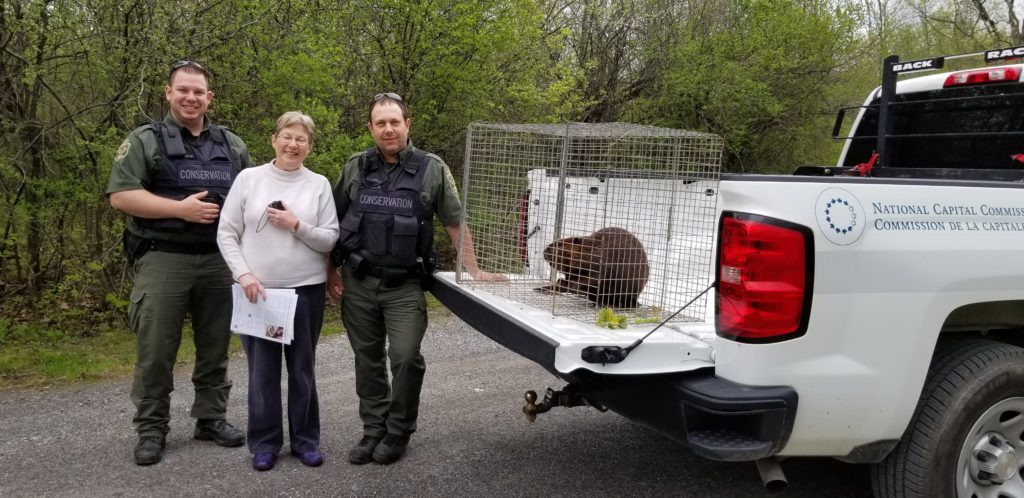
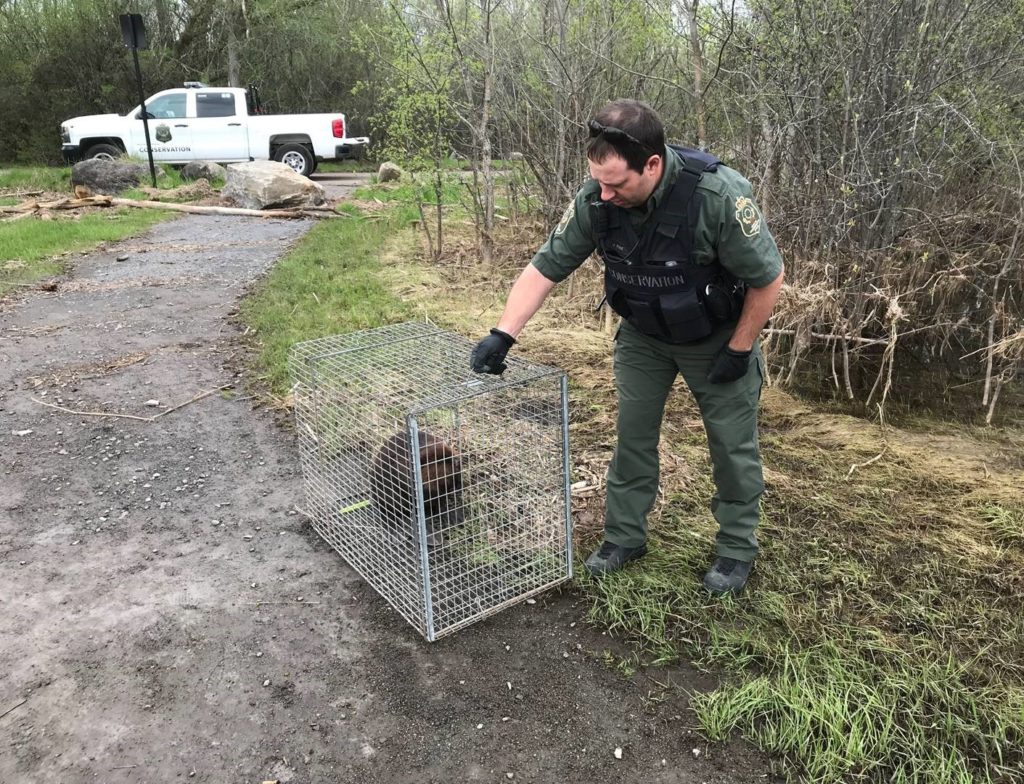
Now for some great photos from that beaver rescue i told you about yesterday in Ottawa parliament. Donna Debreuil sent them last night, and they’re excellent. i don’t know why they didn’t make it to the article but enjoy!



FacebookFacebook
email articleemail article

Weren’t those wonderful photos Rusty shared yesterday? I thought so too, and you probably wished he would share more this morning, but vacation’s over and you’re stuck with regular old me. It’s okay, I have some good news to share, though. Thanks Rusty! Then a thank you to our friends at Safari  west who made another generous donation to our beaver festival this year. There was also a darling little girl who wanted to sit in the very front row because beavers were her favorite animal.

Smart kid.

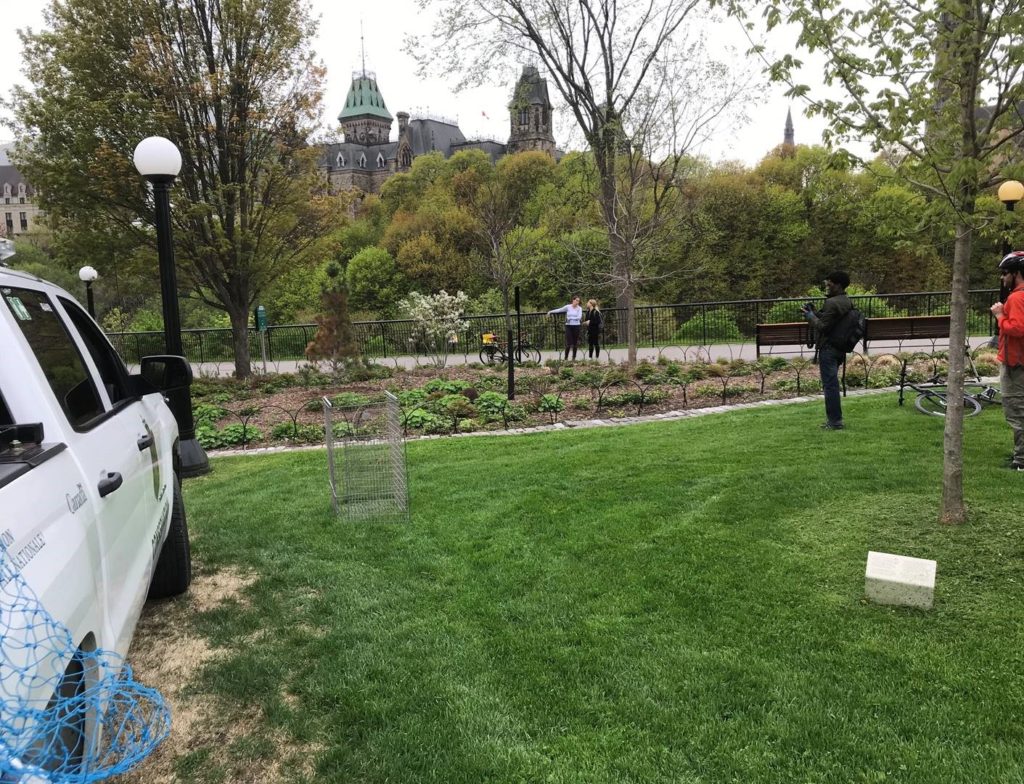
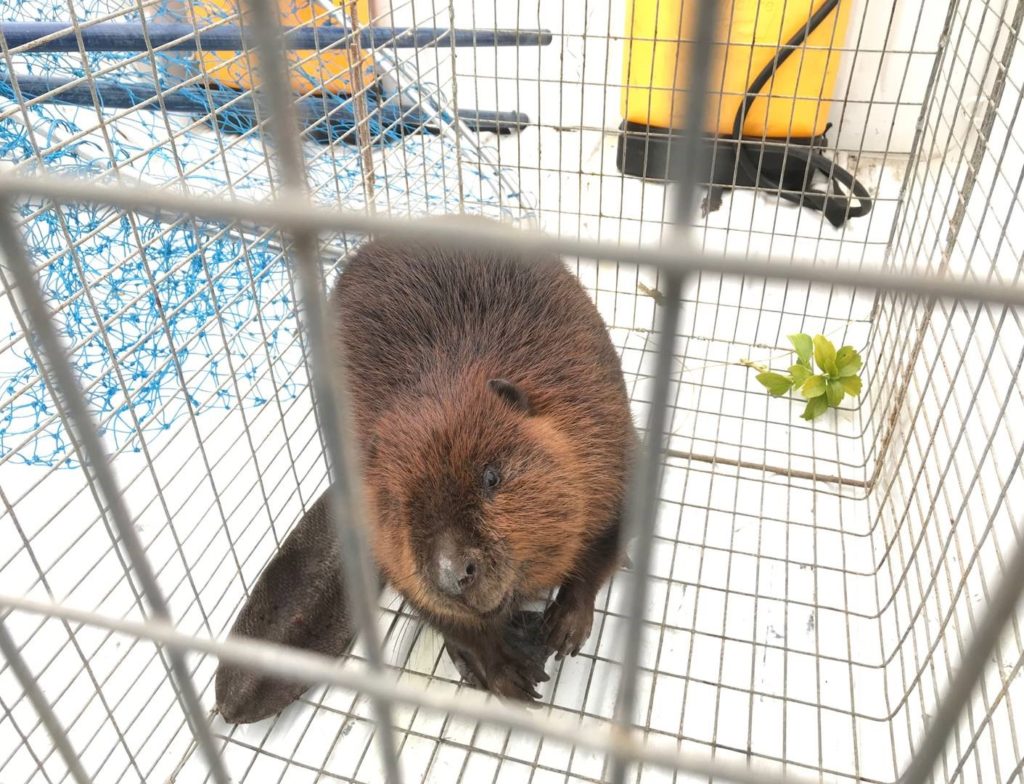
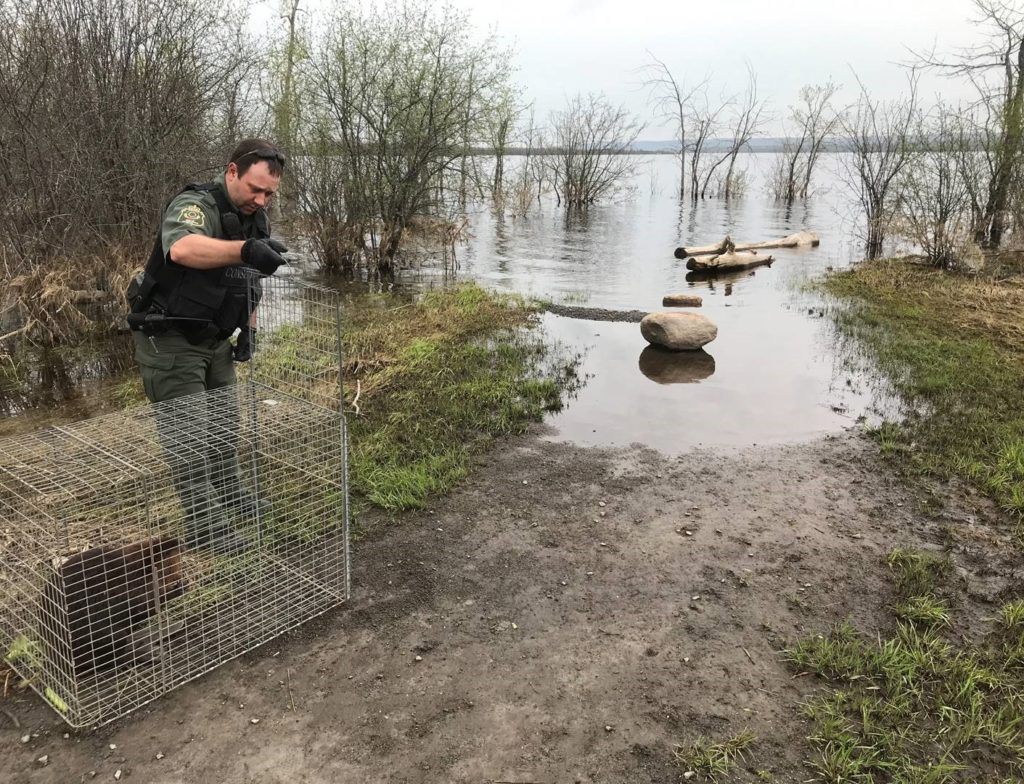
This morning there’s nice beaver news from Ontario thanks to our good friend Donna DeBreuil of the Ottawa Carlson Wildlife Centre.

Carry on, wayward beaver: Our national animal visits Major’s Hill Park

A beaver walks into Major’s Hill Park. Is there anything more majestic? It was a tourist’s dream, this sight that visitors to Major’s Hill Park were treated to Thursday morning.

And this isn’t the first time a wayward beaver has wandered someplace it shouldn’t be in Ottawa. One ended up at a Lone Star restaurant (maybe it wanted some fajitas?).

Another ended up on Sparks Street, where it was rescued by two MPs from Cape Breton who herded it across Wellington Street and back into the Ottawa River.

“(Those MPs) knew what to do. Us Ontarians probably would have panicked and called in the military,” Donna DuBreuil, the founder of Ottawa-Carleton Wildlife Centre, said.

Ahh it pays to have friends in high places! Thanks Donna for calling the right man for the job and getting this little guy back on his way.

Clearly, seeing beavers so far from home isn’t an irregular occurrence. In the case of this Major’s Hill Park beaver, its displacement isn’t even because of the recent floods.

“(Beavers) stay with the colony until they’re two years old, then … they’re shunted out. This is the time of year that’s happening because the female is having newborn kits,” DuBreuil said.

But not to worry; there’s a happy ending for this beaver. The National Capital Commission’s conservation team, headed by senior conservation officer Jason Pink, brought the fella to DuBreuil’s wildlife centre. There, they decided to release it on the west side of the Ottawa River, close to the Green Belt.

“There’s been a lot of criticism over the years about the city not responding humanely to wildlife issues,” she said. “Kudos to the NCC … (for changing) that.”

Hurray beaver finding safe waters! And hurray for helpers who know what to do. Time for the most Canadian photo you will ever see and one of my perennial favorites. Of course this little kit isn’t a disperser, but you get the idea.

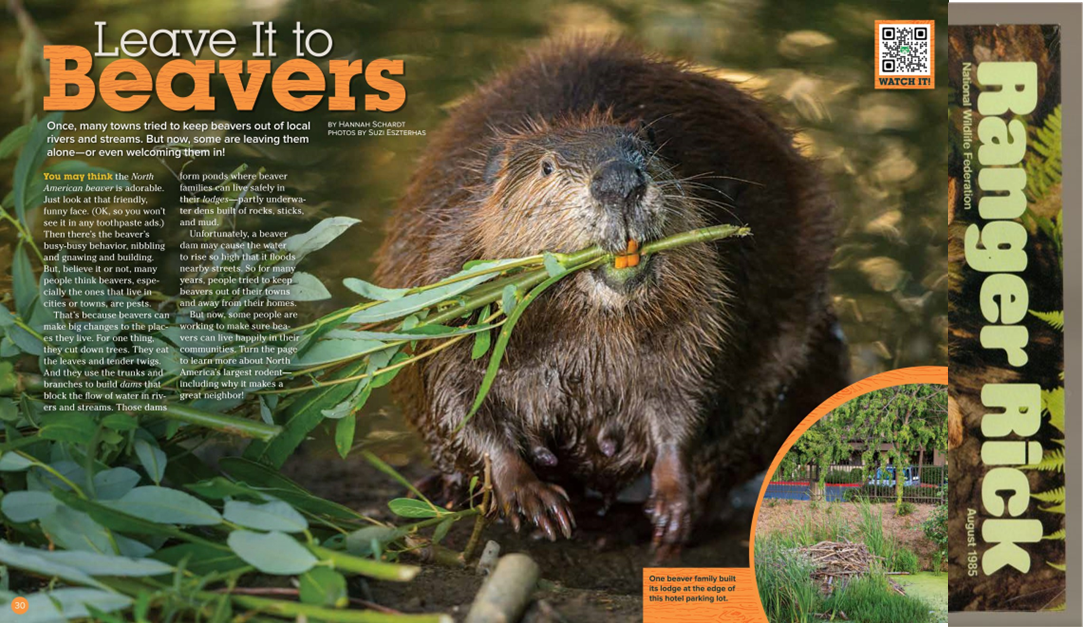
And on the local front, our own Martinez beaver supporter April L. had her letter appear in the recent issue of ranger rick magazine and its a lovely reminder why children and beavers matter. Just in case any body still wondered.


FacebookFacebook
email articleemail article

City of Napa, California Beavers

by Rusty Cohn

Couple of Beavers having a hug session, or maybe a little wrestling.

Rusty Cohn
Rusty Cohn

A very relaxed pair of Beavers

Rusty Cohn

Pair of Kits

Rusty Cohn
Rusty Cohn

Family having dinner together

Rusty Cohn

Kit hitching a ride

Rusty Cohn
Rusty Cohn
Rusty Cohn
Rusty Cohn
Rusty Cohn
Rusty Cohn

FacebookFacebook
email articleemail article

I guess time really does heal all wounds.

Recently I was persuaded to try and get a blurb into Diablo magazine promoting the festival so I wrote a little something up, aiming it toward an audience that had probably heard about the beavers but never followed the story. i wrote up a few pararaphs and sent it off to the editor. But not before I noticed how different it was than what I usually write.

Let me try to explain.

Back when i was fighting every day for the beavers safety I would have HATED an article like this,  I think. It seems strange but in those days I had to be super polite to everyone and never risk upsetting a potential friend. I was working overtime to keep a lid on how I really felt and never show how frustrated I was. But it was very urgent and personal. I could barely stand writing anything that complained about the beavers or put the city in a positive light and made fun of the beaver bruhaha. This particular post is a favorite demonstration of how I was feeling at the time.

But now that I’m finally free to be the queen of beaver snark and say whatever I like it takes no effort at all to tell a glibber story when its called for. I dispatched this article so blithely you might have thought I worked for main street Martinez.

 The Festival Martinez never wanted

A decade ago Martinez found itself at the center of controversy over some furry neighbors nobody expected. A pair of beavers had moved into the creek downtown and started building a dam to raise their family. Fears that the dam would cause flooding spurred a plan to trap the critters, but residents objected – and how. Soon nearly every paper and news channel was talking about the controversy. The beaver bruhaha even made it to national news!

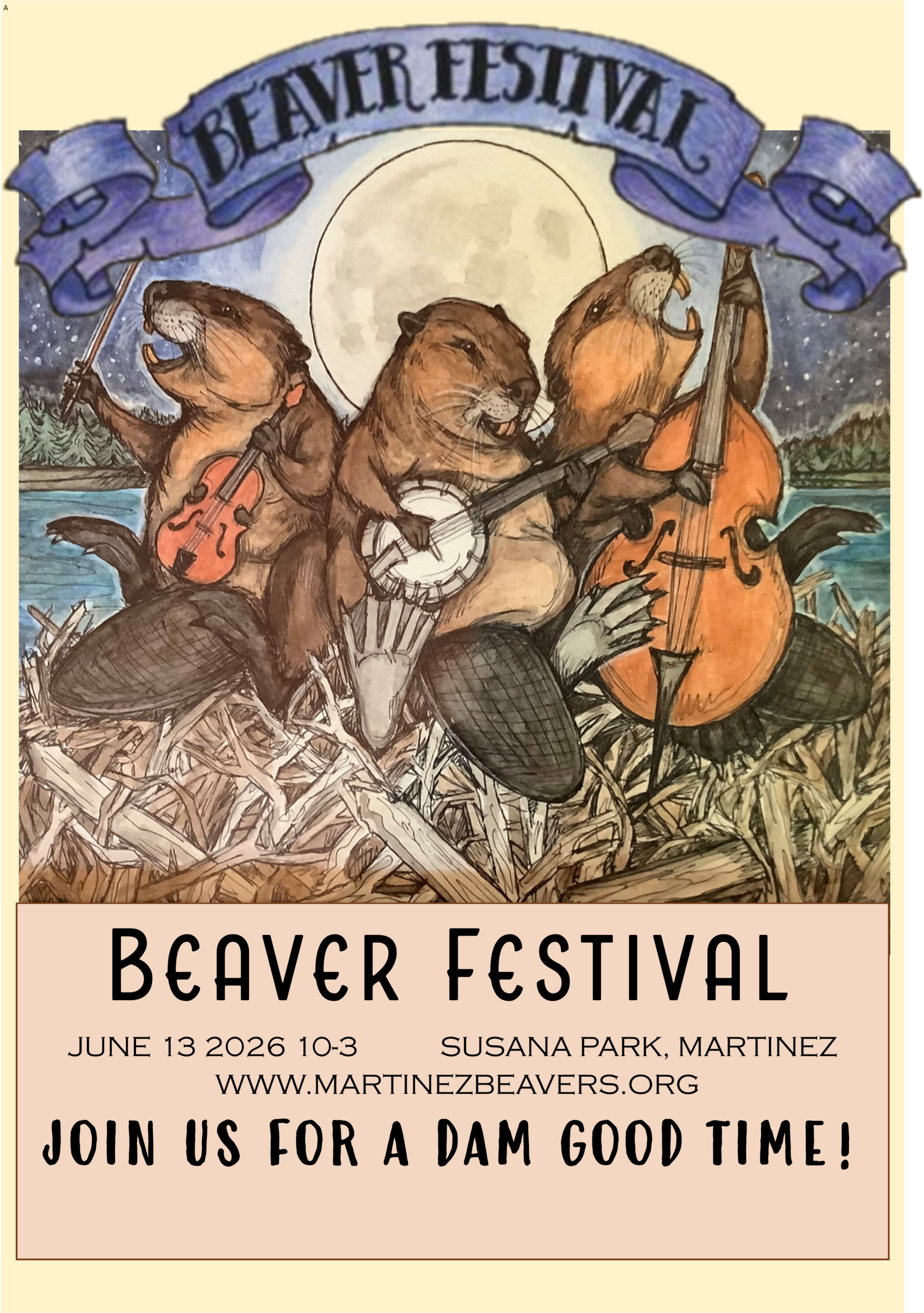
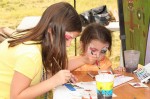
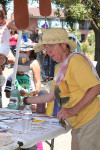
Defenders guessed the beavers would be harder to kill after residents threw a party for them, and in 2008 the first beaver festival was born. Over the years it has grown to be one of the biggest wildlife events in Northern California, drawing conservation and nature groups from more than 5 bay area counties. Live music, children’s activities, a silent auction and beaver tours have made this a popular favorite for nature lovers.

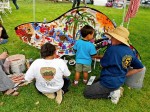
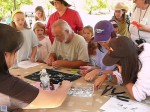
This year, artist Amy G Hall from Napa will be once again be sharing her talents with a 2-day chalk mural showing beavers and the wildlife they sustain in the central plaza. Exhibitors at the event include Native Bird Connections, NorCal bats, the Marine Mammal Center and the many local wildlife organizations. This year children will be invited to participate in a treasure hunt to find the “Lost Key to the Waters”.

They say when life give you lemons you should make lemonade, but when life give you beavers you should definitely celebrate with a dam good festival like this. Come see for yourself!

The editor loved it. He called back to say so and to ask if I was a writer and if I wanted to write on other topics not about beavers. Ha! He also said that he loved the photo I sent of Amy creating her mural and that he was thinking about using it on the cover.

The COVER.

He was a little worried that the photo was too grainy to work, but he was definitely interested. I was busy worrying about my upcoming chat at Safari West so I wasn’t smart enough to be worried about the phone call and we chatted like old friends. It’s always good to be worried about something else so that you don’t realize what an enormous opportunity you are being offered at the time. I find I’m way more mellow.

It would make me very happy if the festival ended up the cover of Diablo magazine. It would make sure the event was well attended, would support Amy’s hard work, would make all the other news outlets cover the story, and be good for beavers everywhere.

It would also make the mayor remember once and for all NOT to kill beavers and endear me even more to his heart. It just doesn’t get any better than that.

I just couldn’t resist.

We’ll see hat happens. Wish beavers luck tonight at Safari West. Rusty Cohn of Napa will be sharing some great photos tomorrow and Cheryl Reynolds will be generously dog-sitting in my absence,


FacebookFacebook
email articleemail article

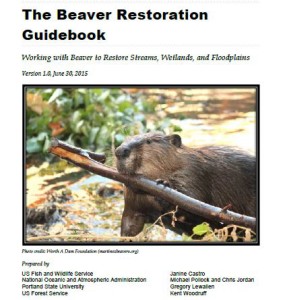
I received the most interesting email from the forest service yesterday. Something tells me you’ll be interested too. But I’ll let you decide. Just check out that title.

Artificial Beaver Dams Hold Promise as a Restoration Tool in California

 North American beavers were once so plentiful in the Scott River Basin of northern California that the area was referred to as “Beaver Valley” by the first Euroamerican fur trappers who travelled there in the early 1830s. But heavy trapping of the fur-bearing rodent—one historical record reports 1,800 beavers trapped by a single man in one month in 1836 along the two forks of the Scott River—ultimately caused the species to rapidly decline in number. As beavers departed the landscape, so, too, did their trademark dams, which played a critical role in shaping the hydrology of the Scott River and its tributaries. Beaver removal, along with activities like mining, deforestation, road construction, and agriculture, have had major impacts on the Scott River Valley watershed over the past 150 years.

Fast forward more than a century, and the Scott River basin and beavers are, once again, intertwined. In 2014, the Scott River Watershed Council, an independent nonprofit organization, launched an initiative to reintroduce the benefits of beaver dams to the basin by building “beaver dam analogues,” also known as BDAs. These structures, which are made of wooden posts woven with vegetation and sediment, are strategically placed in streams to mimic the effects of natural beaver dams. The streams included in the project flow through private lands and are important habitat for federal Endangered Species Act-listed southern Oregon/northern California coast coho salmon. The council installed the BDAs with the goals of improving instream habitat for salmon, raising groundwater levels, and reducing stream channel incision.
Ohh do you hear that? That’s as near as you’re going to ever get to hearing the USDA singing our song. Savor this moment. Shh it gets better.

To date, 20 BDA structures have been installed at six sites and the council has plans for more. Beavers have been active, or have taken over maintenance, at all of the sites, and agency personnel and landowners feel that beaver populations in the Scott Valley are increasing in number.

“Most of the private landowners involved in this project are ranchers who also grow hay and who have largely positive views of beavers and beaver dams, so long as they do not interfere with irrigation infrastructure,” said Susan Charnley, a Pacific Northwest Research Station research social scientist and author of a case study on the project. “Monitoring data and interviews with stakeholders indicate that BDAs are starting to achieve their goals and are benefitting both landowners and fish.”

The case study report includes a detailed description of the pioneering restoration project – the first of its kind in California – and the experiences of partners and stakeholders involved in it – as well as a discussion of the lessons learned.

Although this watershed restoration project was the first in California, results are showing promise, and other California groups are starting to use this restoration technique. The project offers important lessons for undertaking beaver-related restoration on private lands across the west. 

Read the California case study online

Tadaa!!! The Forest service is installing beaver dams and thinking they do REMARKABLE things for the watershed. And hey once humans start these dams actual beavers come and take them over! Saving water, helping salmon, preventing floods, and will you look at that, raisin the water table so all those hay farmers can water their crop!

BEAVER FESTIVAL XVII

DONATE

Beaver Interactive: Click to view

TREE PROTECTION

BAY AREA PODCAST

Our story told around the county

LASSIE INVENTS BDA

CONTACT US

URBAN BEAVERS

LASSIE AND BEAVERS

Ten Years

The Beaver Cheat Sheet

Restoration

RANGER RICK

Ranger rick

The meeting that started it all

Past Reports

June 2026
M T W T F S S
1234567
891011121314
15161718192021
22232425262728
2930  

Story By Year